















16 min
Driving on Georgia’s mountain roads with children is an exciting adventure, but it requires special attention to child safety. Families planning a road trip in Georgia with a rental car should be aware of the current rules for transporting children. Here, we cover Georgia’s traffic regulations for child transportation (as of late 2025), child car seat requirements, fines for violations, and tips for tourists. We also compare Georgian rules with those in other countries (Russia, Belarus, EU, Israel, Asia) and list mandatory and recommended safety measures. Each section includes concise takeaways to help you quickly grasp key points.
Child Transportation Rules in Georgia: Law and Fines
Georgian law sets clear requirements for transporting minors. Key provisions of Georgia’s traffic rules for traveling with children:
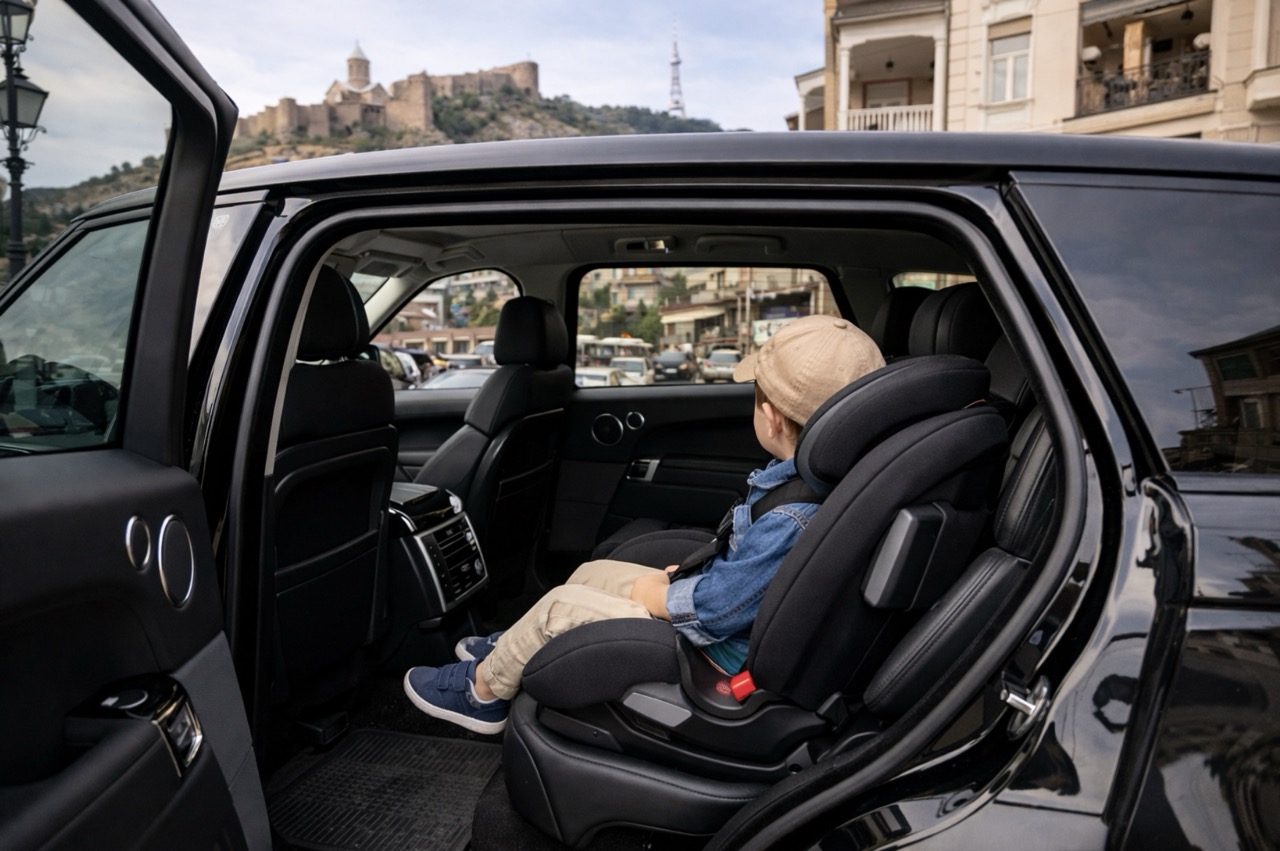
- Rear seat only: Children under 12 are not allowed to sit in the front seat of a passenger car. They must ride in the back – this is both a legal requirement and a basic safety measure.
- Children under 3 years: Infants under 3 may ride either in a proper child car seat or on the lap of a seat-belted adult (16+) in the back seat. Important: one adult may hold only one child, and the adult must be buckled in. While the law allows lap travel, safety experts and international standards strongly discourage this – a car seat provides significantly better protection.
- Prohibited unsafe transport methods: Children under 12 cannot ride on motorcycles, mopeds, or certain ATVs where a car seat cannot be installed. Standing passengers are prohibited – children must always be seated in proper seats.
- Do not leave children alone: Georgian law explicitly forbids leaving children under 6 unattended in a parked car. Remember this rule during stops – in hot weather, cars heat up quickly, posing a severe risk.
Fines for violations: Non-compliance incurs a fine of 40 GEL (approx. $15). For example, placing a child under 12 in the front seat or failing to use a car seat or seat belt allows police to fine the driver. Although the fine is relatively small, these rules are designed to protect your child’s life and health.
Takeaway: In Georgia, children under 12 must ride in the back seat, and infants should use a car seat (lap travel allowed only up to 3 years, though unsafe). Violations carry a 40 GEL fine. Following the rules ensures the safety of young passengers.
Child Car Seat Requirements: Age, Weight, and Height
Even experienced parents often ask: which car seat is suitable for my child? Choosing and using the right child restraint system is a key safety factor. Georgian rules require car seats to match the child’s height and weight. Follow international classifications:
- Group 0/0+ (newborns ~0–1.5 years): Weight up to ~10–13 kg. Use a carrycot or group 0+ seat installed rear-facing. Infants ride semi-reclined or lying down, secured with internal harnesses. Seats usually have a carry handle; disable the front airbag if installed on the front seat (though in Georgia, infants must ride in the back).
- Group 1 (toddlers ~1–4 years): Weight ~9–18 kg. Seat installed forward-facing, secured with seat belt or ISOFIX. Child buckled with internal harness.
- Group 2 (preschoolers ~4–7 years): Weight ~15–25 kg. Usually a high-back booster or convertible seat. Child uses car’s seat belt, elevated by booster. Backrest adds support and protection.
- Group 3 (young schoolchildren ~6–12 years): Weight ~22–36 kg (up to ~12 years). Booster (sometimes without backrest) for children not tall enough for proper seat belt positioning. Seat belt must cross shoulder, not neck – booster ensures correct alignment. EU standards require child restraints until ~135–150 cm tall. After that, normal seat belt may be used without booster.
Beyond weight groups (ECE R44/04), modern i-Size (ECE R129) seats classify by height. For example, i-Size seats allow rear-facing travel up to 105 cm (~4 years). The main point: the seat must fit the child. Too large reduces restraint effectiveness; too small is uncomfortable and unsafe. Always check the seat’s weight/height range and install correctly.
Takeaway: Use a car seat matching your child’s age, weight, and height. Newborns ride rear-facing, preschoolers in seats or boosters, all properly harnessed. Seats should be certified (ECE R44/04 or R129) and correctly installed – a properly chosen seat is the foundation of a safe journey.
Tourist Considerations: Car Rentals and Child Seats
Do I need to bring my own car seat? Can I go without one? These questions often concern tourists renting cars in Georgia. Key points:
- Georgian rules apply to everyone: Local or foreign, traffic laws are mandatory. Children must ride according to the same rules. Lap travel for under 3 years exists but is not recommended. In most other countries, this practice is considered unsafe, so it’s better to have a proper seat.
- Rental car seats: Most Georgian rental companies offer child seats. Our company provides seats free on request – specify the age/size of your child when booking. Seats cover different age groups (0+/1 for infants, 2/3 boosters for older children). Availability may be limited during peak season, so book in advance.
- If traveling in your own car: Ensure your seat meets requirements. European tourists can continue using familiar boosters – fully compliant with Georgian rules. Buckle both children and adults. Optional: “Baby on board” sticker – not required in Georgia but may alert other drivers.
- Taxis and transfers: Taxi vehicles usually lack child seats. Georgian law does not mandate them. Bring a portable booster or request a service with a seat. If unavailable, buckle your child with you and exercise extra caution.
Takeaway: Tourists should arrange a car seat in advance. We provide seats free on request. Avoid lap travel even if technically allowed for children under 3 – the risk is too high. Proper safety ensures a worry-free trip.
Rules in Other Countries: Comparison with Georgia
Understanding differences in child transport rules helps international travelers. Georgian rules are somewhat lenient (allowing lap travel under 3). Here’s a comparison with other countries:
- Russia: Strict, similar to EU. Children under 12 must use restraint systems. Under 7 – car seat or booster mandatory in rear; 7–11 – rear seat with seat belt allowed, front seat requires car seat until 12. Fines: ~3,000 RUB (~$35). Georgian rules are softer, but higher safety standards are recommended.
- Belarus: Similar to Russia. Under 12 or below 150 cm – car seat/booster required. Front seat only with car seat; rear-facing front seat prohibited if airbag active. Lap travel strictly forbidden. Fines: up to 98 BYN (~$30).
- European Union: Children under 12 or ~135 cm must use car seat/booster. In some countries (Germany, Italy, France), requirement up to 150 cm (~11–12 years). Lap travel prohibited; rear-facing mandatory for infants. Fines significant (Italy €80–€323).
- Israel: Similar to EU, lower threshold: under 8 or 145 cm must use seat/booster. Infants under 1 year – rear-facing only; fines: 250 ILS + 6 points. Not using a seat for under 8 fines ~750 ILS (~$200). Front seat allowed only with car seat; back seats preferred.
- Asia: Rules vary. Developed East Asian countries (Japan, South Korea, Singapore) follow EU-like standards: e.g., Japan – children under 6 or below 140 cm must use seat/booster. Developing regions may have lax rules; e.g., Thailand enacted law in 2022 for under 6. China gradually enforcing standards. Georgian rules (2025) align more with global norms, except the lap-travel exception under 3.
Takeaway: Compared to Russia, Belarus, EU, and Israel, Georgia’s rules are slightly more lenient (lap travel under 3, no booster mandatory after 3). Global trend: children under 12/~135 cm must use car seats or boosters; lap travel prohibited. For trips, follow the strictest rules for maximum safety.
Mandatory and Recommended Safety Measures
Having a car seat is not enough – other measures are crucial for child safety. Below are mandatory requirements and additional recommendations for traveling with children:
- Buckle all passengers: Everyone must be buckled. Ensure belts are correctly positioned (shoulder/chest, lap over hips). Never hold a child on a buckled adult – each must have their own restraint.
- Proper seat installation: Install per manufacturer instructions – with seat belt or ISOFIX/LATCH. Seat should not move more than a few centimeters. Backrest angle ~45° for newborns; boosters must guide the car’s belt correctly.
- Lock doors and windows: Use child locks on rear doors. Lock windows as needed.
- No children on laps or outside seat while moving: Even if fussy, children must remain restrained. Stop to adjust or calm them. Lap travel prohibited except under 3 years (adult buckled).
- Remove loose items from the cabin: Store heavy items in the trunk; small objects in compartments. Soft toys preferred.
- Control cabin climate: Maintain comfortable temperature. Never leave children alone in a car. Remove thick jackets before belting; cover with blanket if needed.
- Lead by example: Follow traffic rules. Children model adult behavior – emphasize safety.
Takeaway: Maximum safety comes from: proper seat selection/installation, buckling everyone, locking doors, securing items, controlling climate. These steps significantly reduce road risks.
Tips for Driving with Children in Georgia
Georgia’s roads are scenic but challenging. Mountain terrain, switchbacks, and changing weather demand careful driving. Here are tips for comfort and safety when driving with children:
- Plan your route and timing: Mountain roads (e.g., Kazbegi via Georgian Military Highway, Svaneti switchbacks, Batumi–Kutaisi passes) may take longer than GPS shows. Schedule stops every ~1.5–2 hours for children to stretch and for driver rest.
- Avoid night driving: Avoid unfamiliar mountain roads at night. Visibility is lower; risks higher. Easier to assist children during the day.
- Prevent motion sickness: Avoid heavy meals before travel. Offer water in small sips. Consider pediatric remedies if needed. Drive smoothly on switchbacks; stop if the child feels nauseous. Distraction (songs, stories) may help.
- Mountain driving style: Use lower gear on descents, avoid overheating brakes. Enter turns slowly, signal intentions. Reduce speed on poor surfaces. In rain/fog, exercise extra caution. Minimize sudden maneuvers for children’s comfort.
- Account for temperature changes: Prepare for altitude and coastal heat differences. Carry warm clothes and sun protection. In winter, ensure proper tires/chains. Maintain comfortable cabin temperature and monitor children.
- Entertainment and comfort: Bring toys, books, or download cartoons (with power bank). Keep wipes, trash bags, water, and snacks handy. Calm children = calmer driver.
Takeaway: For trips in Georgia with children, planning and caution are key. Travel slowly, make stops, prevent motion sickness, ensure comfort. This ensures an enjoyable experience for all.
Driving in Georgia with children is a wonderful experience if approached responsibly. Follow local child transport rules, adhere to global safety best practices, ensure an appropriate car seat (we provide one free for convenience), plan routes considering children’s needs, drive attentively, and be patient. This way, Georgia’s mountains, coasts, and cities will reveal their most welcoming side, while your family remains safe every kilometer. Enjoy your trip and safe travels!