















10 min
Georgia is a hospitable Caucasian country with a rich culture and a unique language. Many tourists worry about the language barrier when traveling there. How can you communicate in a restaurant, ask for directions, or thank the host of a guesthouse? In this guide, as an experienced travel company, we will explain the official language of Georgia and how widely Russian and English are understood there. We will provide practical advice on situations where you can rely on locals’ knowledge of foreign languages, teach you a few simple Georgian phrases, and share amusing stories from our travelers’ experiences. The friendly tone of Georgian hospitality and a few words in the local language will surely help you feel “at home” even far from home!
The Official Language and Linguistic Environment of Georgia
The Alphabet Tower in Batumi – a 130-meter structure wrapped in a spiral of 33 letters of the Georgian alphabet – symbolizes Georgians’ love for their native language. The Georgian language (ქართული ენა, kartuli ena) is the sole official language of Georgia. It is unique: it belongs to the Kartvelian language family and is unlike any other major language in the world. Its writing system is also special – Georgians use an original alphabet of 33 letters (visible on the famous Alphabet Tower in Batumi) that has no equivalents. Without preparation, understanding Georgian speech is virtually impossible: the sounds and words are entirely different from European languages, and the meaning of words is often recognized only through context and intonation. But don’t be alarmed – locals do not expect tourists to know Georgian and are always ready to help with a smile.
Historically, besides Georgian, many people in the country speak other languages. During the USSR era, Russian was the language of interethnic communication, so practically every older Georgian speaks Russian fluently. The younger generation, however, grew up in independent Georgia and more often studies English as the first foreign language in school – this language gradually replaces Russian in cities and in education. Nevertheless, in practice, Russian is still widely understood: a significant part of the population knows it at least at a basic level, especially older people and those who have worked with tourists from post-Soviet countries. English has gained popularity over the past decades – many young Georgians speak it, especially in large cities and in tourism and service sectors. Often, representatives of the new generation speak English better than Russian, while the older generation is the opposite. As a result, today, almost every worker in Georgia’s tourism sector knows either Russian or English (and often both). Many Georgians are actually trilingual – they speak their native Georgian, Russian, and English fluently.
Besides these languages, in multicultural Georgia, you may also hear other languages. For example, in the Samegrelo region, many locals speak Megrelian in addition to standard Georgian, and in the mountains of Svaneti – Svan. In the autonomous republic of Abkhazia, alongside Georgian, Abkhaz is officially recognized. However, on typical trips around Georgia, tourists are unlikely to need these rare languages – the vast majority of the population speaks Georgian, and almost all official information is duplicated in it. For communication with travelers, Russian and English remain the primary languages.
Practical Tips: Which Language to Choose as a Tourist
1. Communication in cities and tourist areas. In Georgia’s major cities – Tbilisi, Batumi, Kutaisi, and others – the language barrier is minimal. In the capital, Tbilisi, the younger generation speaks English well, while many middle-aged and older residents know Russian. Hotel staff, large restaurants, travel agencies, guides, and museum cashiers usually speak conversational English. In many establishments, staff also understand Russian – Georgia is oriented toward guests from various countries. For example, in the popular resort city of Batumi on the coast, you can practically always communicate in Russian – this resort traditionally attracts many tourists from CIS countries, so locals are used to speaking Russian. In Tbilisi, in everyday situations, some people switch to Russian more often, while others use English – according to tourists’ feedback, the ratio of Russian to English use in the capital is roughly 60/40 in favor of Russian (including foreign students working in the service sector). Thus, in key locations – popular resorts, the capital, and well-known tourist sites – you will almost certainly find a common language with locals. If a hotel or café staff member does not understand you in Russian, they will usually call a colleague who can help. Georgians are generally very friendly and make an effort to understand the guest, even if they speak another language.
2. Trips to regions and small villages. Outside main tourist areas, the situation may differ slightly. In rural areas and remote corners (for example, highland villages), not all young residents speak foreign languages well, as schools previously taught mainly Georgian and a little English. However, many older people in the regions remember Russian from the Soviet era. Therefore, in the countryside, it can sometimes be easier to communicate with a grandmother in broken Russian than in English. Nevertheless, even in the most remote villages, people will try to help – the language barrier rarely becomes an insurmountable obstacle. If your interlocutor does not understand a word in English or Russian, gestures, smiles, and modern technology will come to the rescue. You can always point to a place on a map or use a translator on your smartphone – Georgia has good mobile internet coverage, and in case of no connection, many download offline translators in advance. Locals appreciate tourists’ initiative to understand them: they see your efforts and may even gather the whole neighborhood to collectively give the right advice. Such situations sometimes lead to amusing mishaps but often become part of pleasant travel memories.
3. Russian or English – which to choose? Tourists from post-Soviet countries can usually rely on Russian – as we noted, “almost everyone speaks at least a little of it.” Travelers who speak only English also have no problem being understood, especially among young people and in cities. If you know both languages, first assess whom you are speaking with. There is an unwritten rule: greet first in Georgian (“gamardjoba!”), then ask how your interlocutor prefers to continue the conversation – in English or Russian. This approach is considered the most polite: you show respect for the country and give the person a choice of language. Many young Georgians, especially in Tbilisi, truly prefer to speak English with tourists (some simply do not know Russian well or feel wary of it for political reasons). Older people, on the other hand, more readily switch to Russian – they often find it harder to communicate in English. Therefore, in the city, you can start a conversation in English with young people and try Russian when speaking with a taxi driver or a middle-aged vendor. In any case, an initial greeting in the local language works wonders: upon hearing the friendly “gamardjoba,” Georgians smile broadly and noticeably warm up in conversation.
4. Useful tips. Pay attention to the languages of signs and pointers around you. City names and major road signs in Georgia are usually duplicated in Georgian and English (Latin script) – don’t get lost. Street names in cities, however, are often written only in Georgian. Therefore, save your hotel address in its original form in advance or take a business card to show locals if needed. By the way, learning the Georgian alphabet is not very difficult if you have time and desire: the alphabet is beautiful, reminiscent of calligraphy, and it can be useful at least for reading signs. But it is not mandatory – most tourists manage perfectly fine without it. Just learn a few phrases and keep a translator handy. Georgians value respect for their culture. Even a few words spoken with an accent can endear you to anyone. One of our guides jokes that a tourist needs three words in Georgian: “gamardjoba,” “madloba,” and “gaumardjos!” The first – for greeting, the second – to thank, and the third – to toast to Georgia’s health ???? (the toast “gaumardjos” means “Long live!..”).
Below, we have prepared a small phrasebook – it will help you master basic polite expressions.
Useful Georgian Phrases
(transcription in parentheses, translation given in Russian)
- გამარჯობა (gamardjoba) — “Hello”
- ნაყოფამდის (nakhvamdis) — “Goodbye”
- გმადლობ(თ) (madloba / gmadlobt) — “Thank you”
- თუ შეიძლება (tu sheidzleba) — “Please” (when requesting)
- დიახ / კი (diakh / ki) — “Yes” (formal / informal)
- არა (ara) — “No”
- უკაცრავად (ukatsravad) — “Excuse me / Sorry” (e.g., to get attention)
- რა ღირს? (ra ghirs?) — “How much is it?” (asking about price)
- სად არის ტუალეტი? (sad aris tualeti?) — “Where is the restroom?”
Of course, this is only a small selection of possible phrases, but they are very helpful in typical situations. Tip: it’s best to start a conversation with locals using a Georgian greeting. Even if your vocabulary is limited to a few expressions, use them – it shows respect for the culture. Georgians highly value such gestures and respond warmly. A market vendor, hearing you say „რა ღირს?“ (“ra ghirs?” – how much is it?), will most likely tell the real price without a tourist markup. In response to your „მადლობა“ (“madloba,” thank you), you will probably hear a friendly „არაფრის!“ – meaning “you’re welcome.”
By the way, if you really want to impress locals and elicit delight, you can try pronouncing a playful tongue-twister Georgians use to test foreigners: ბაყაყი წყალში ყიყინებს (“bakaqi ts’qalshi k’ikinebs” – literally “The frog croaks in the water”). Correctly pronouncing this phrase is only possible for a native speaker, but the humorous attempt invariably draws loud applause and guarantees maximum hospitality! Don’t be afraid to play with the language – your effort will surely be praised.
From Our Travelers’ Experience
The language barrier in Georgia sometimes turns into funny stories, as our clients can confirm. For example, tourist Anna shared how she initially felt shy speaking broken Georgian. On her first day in Tbilisi, she entered a small family café and timidly said to the waiter: «გამრაჯობა, ერთი ყავა, თუ შეიძლება…» – which was supposed to mean “hello, one coffee, please.” The café owner made a serious face… then broke into a smile and replied in Russian: “Of course, it will be ready shortly!” He was so pleased that the guest tried to speak his language that he brought her a treat with the coffee – a piece of homemade pie for free. Laughing, Anna admitted that since then she always started interactions with locals with the magical words “gamardjoba” and “madloba” – and every time saw genuine smiles in response.
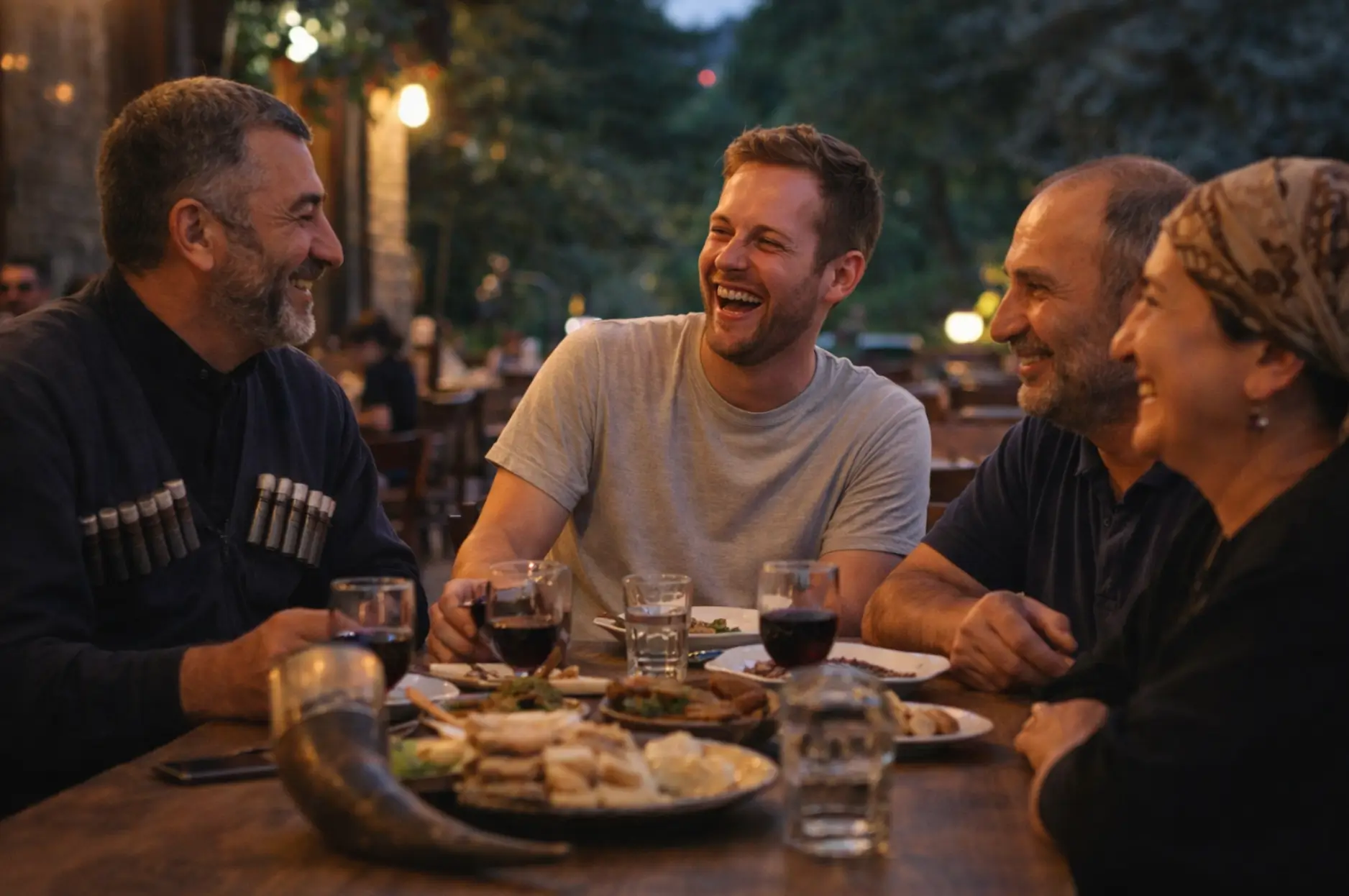
Another case involved a couple from Kyiv traveling through mountain villages. They stayed overnight in a guesthouse in Svaneti, where the elderly hostess spoke only Georgian and the local Svan dialect. She knew neither Russian nor English, and the tourists did not know Georgian. Nevertheless, with gestures, smiles, and Google Translate, both sides quickly found common ground. The hostess taught the guests a couple of toasts in Georgian, served them homemade wine, and in the morning saw them off like family, hugging them with the words «კარგად, გénaცwali!» – which meant “Farewell, dear ones!” Not knowing the language did not hinder the travelers at all – on the contrary, it turned an ordinary stay into a heartfelt cultural evening. There are many such stories: some tourists accidentally said a word resembling a vulgar Georgian term and caused bursts of laughter among locals, while others learned the toast „Sakartvelos gaumardjos!“ (“Long live Georgia!”) and received applause at the table.
In conclusion: travel to Georgia without fear of not understanding or being misunderstood. The linguistic environment there is very friendly for tourists. Russian-speaking travelers feel especially comfortable: Russian signs, Russian-speaking guides, and services for guests from the CIS are everywhere. English-speaking tourists also feel confident – young people and service personnel actively practice English. And the Georgian language itself is a highlight, a bonus to your experience. Try to learn at least a few phrases: you will likely enjoy playing with these unusual, sonorous words, and locals will appreciate it. Georgia is rapidly developing and becoming increasingly international: a generation fluent in foreign languages is growing, more bilingual signs appear, services such as menus and audio guides are translated into English and Russian. Yet Georgian hospitality and warmth remain unchanged – you will be understood from half a word, even if pronounced with an accent. As Georgians say, «ჯარჯობდა გენაცვალე» – “Be healthy, dear friends!” Let languages not become a barrier but rather enrich your journey and car rental. მადლობა – thank you, and see you in sunny Georgia!