















17 min
Georgia is an amazing country for road trips. The roads connect the seaside with high mountains, ancient monasteries with bustling cities. As a car rental company, we aim to help you see all the beauty of Georgia safely. From our own experience, we know there are destinations where it’s better not to go by rental car. These restrictions are not arbitrary; they are based on real incidents: some routes too often end with a ruined holiday, towing, and expensive repairs. Our goal is to protect you from such problems and make your trip pleasant and safe.
Why These Restrictions Exist
To help you understand the reasons behind these prohibitions, here are the main factors why we do not recommend certain roads and regions:
- Dangerous road conditions. In some areas there is no asphalt—only broken dirt roads with potholes, rocks, and steep drops. Crossing mountain passes on such roads is very risky in a standard car. What is manageable for a prepared 4×4 can be disastrous for a city-type rental vehicle.
- Lack of insurance coverage. Insurance does not apply on the restricted routes and in remote regions. If something happens to the car there, the renter is fully responsible for all costs. Neither comprehensive insurance nor extended coverage will cover damage on forbidden roads.
- Vehicle wear and damage. Driving on rough off-road terrain seriously damages the suspension, tires, and mechanical components. The rental agreement explicitly states that the car must not be used outside of its intended purpose—such as driving where there is no proper road surface. If you deliberately violate these terms, the company may charge fines and require compensation. Simply put, repairing a “destroyed” suspension can be extremely expensive.
- Unavailability of assistance. Most “forbidden” routes are far from towns and rescue services. In the mountains, there is often no mobile signal—you won’t even be able to call us or 112. Even if signal appears, sending a tow truck to such places is difficult and slow, and sometimes physically impossible until weather conditions improve. You risk being stranded without help, fuel, or food for a long time.
Remember that we track the location of our vehicles for your safety. If the car enters a restricted region, we can see it via GPS. In critical situations, we may contact you to clarify the situation, and in cases of serious violation, we can even remotely block the vehicle. These measures are in place to prevent accidents before they happen. In simple terms, we do not want your long-awaited holiday to turn into a dangerous rescue operation. Believe us, such cases have happened—and now we aim to prevent them.
So what are these routes, and why are they so risky? Below we provide a detailed overview of specific roads and regions in Georgia where you should not go with a rental car. We also explain why they are dangerous, what incidents have occurred in practice, and how you can visit these places safely without violating rental terms.
Dangerous Mountain Routes (Forbidden Roads)
Some roads in Georgia may appear on a map as a convenient shortcut or an enticing adventure route. But if you are not in a prepared 4×4 with serious off-road experience, avoid them. GPS navigation (especially Google Maps) sometimes guides travelers along these paths without warning about road conditions. As a result, tourists end up on broken mountain switchbacks where 10 km/h is already an achievement and regret not knowing the risks beforehand. Below are the three most well-known dangerous routes forbidden for rental cars.
Akhaltsikhe – Batumi via Goderdzi Pass
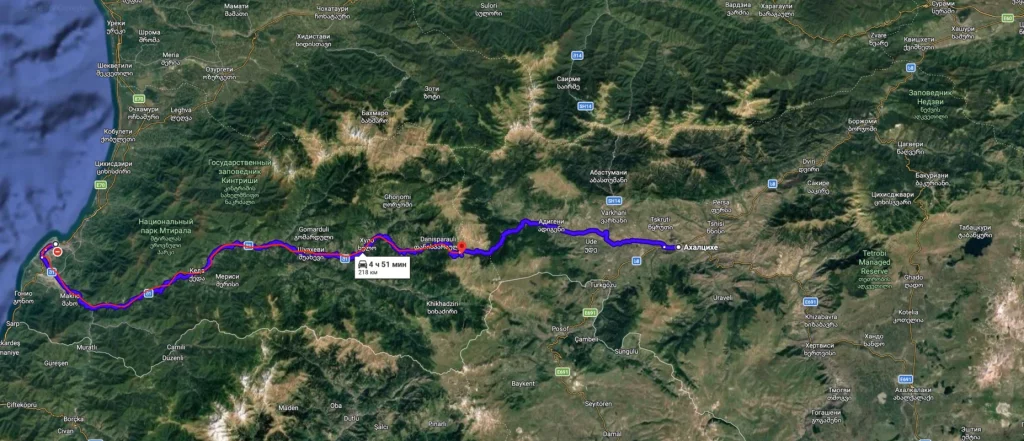
If you plan a route from Tbilisi or Kutaisi to Batumi, many maps by default route through Akhaltsikhe and then Goderdzi Pass. On paper, it looks attractive—a direct path through the mountains, shorter than the detour via Kutaisi. But under no circumstances agree to drive Goderdzi Pass in a standard car! This is one of the main forbidden routes. The reasons are simple: for about 30–40 km between the village of Khulo (Adjara) and the Goderdzi resort there is no asphalt at all. The road is a mountain switchback made of gravel, dirt, and rocks. On ascents and descents, the car shakes, with many sharp turns without guardrails. In dry weather there is dust and potholes; in rain, mud knee-deep. Navigation may show ~5 hours from Akhaltsikhe to Batumi, but in reality, an unprepared driver will spend 8–9 hours—the most stressful of your life.
We have had clients who ignored warnings and went through Goderdzi, then called us in distress. One crew tore two tires on rocks—only one spare, no help nearby. Others got stuck in mud after rain on the pass and needed the whole village to help pull the car out. Even local road service tractors hesitate to attempt the difficult sections of this road. Insurance does not cover the pass—so all damage and expenses fall on the travelers. Therefore, we strictly forbid the Akhaltsikhe–Batumi route via Goderdzi Pass. From the capital and central Georgia to Batumi, take the detour via Kutaisi. Yes, it’s a few extra kilometers, but the entire route is on proper roads: for example, Akhaltsikhe – Borjomi – Kutaisi – Batumi is completely safe for any car. Trust us, it’s better to spend an extra hour than to pull your car out of a mountain ditch.
Lentekhi – Ushguli – Mestia (Zagari Pass)
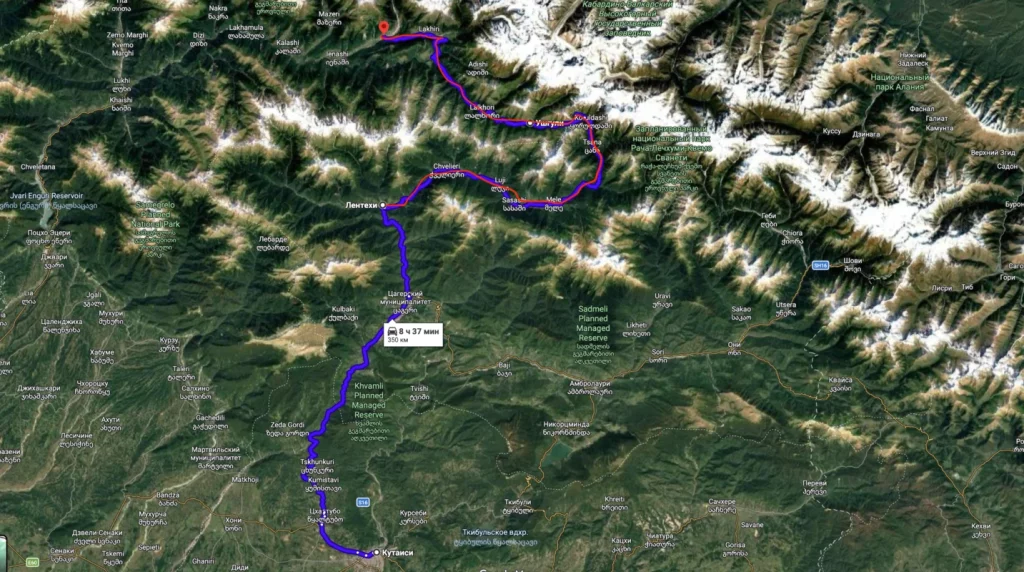
Another “trap” set by navigators is the route to Upper Svaneti via Lentekhi and Zagari Pass to Ushguli. If traveling from Kutaisi to Mestia, this path may also lure you. Warning: do not drive directly from Lentekhi to Ushguli in a rental car! This high-mountain route is open only in summer (May to September) and even then only for prepared 4x4s with very experienced drivers. The Lentekhi–Ushguli road is a narrow mountain trail, partly carved into slopes. There is no asphalt; the surface is dirt, large rocks, river crossings, and muddy ruts. Zagari Pass is about 2,600 m high, and weather can change instantly—you may encounter snow or heavy rain even in midsummer. In colder seasons, the road is completely snowed in and closed until the snow melts.
We’ve heard from extreme travelers about the beauty of the area but also received distress calls: “Help, we slid off the Lentekhi–Ushguli route…” One of our cars returned with a cracked oil pan and destroyed shock absorbers—insurance did not cover it. Therefore, absolutely forbidden: the Lentekhi – Ushguli – Mestia route is off-limits for standard rental cars. Even if you have a capable 4×4, you may go only with explicit permission from the rental company (rarely granted for an additional fee, fully equipped). Overall, we strongly advise against taking this risk. To see Ushguli safely, plan an alternative route: drive the main road through Zugdidi to Mestia (the paved Military–Sukhumi highway via Jvari Pass is allowed). From Mestia, you can visit Ushguli on a guided jeep tour with a local driver. This way you safely reach Europe’s highest village without incidents. Many local guides in Mestia offer tours to Ushguli—take advantage of them instead of risking a rental car off-road.
Sairme – Abastumani Mountain Road (Zekari Pass)
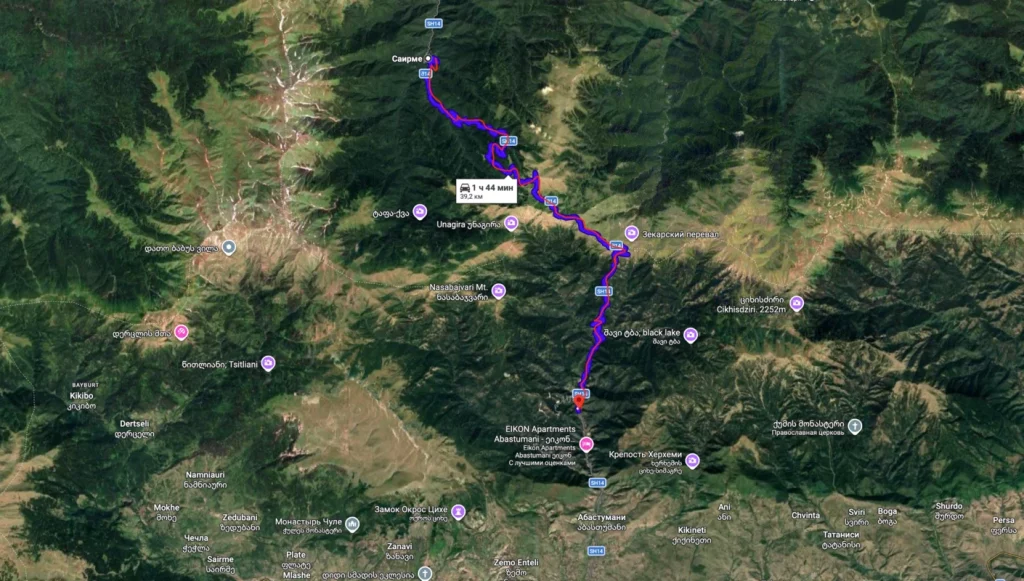
The route connecting the Sairme resort (Imereti) with the village of Abastumani (Samtskhe–Javakheti) is famous for its beauty. Tourists enjoying Sairme’s hot springs sometimes want to cut through to Abastumani via the Zekari Pass. But we do not rent cars for this adventure. Reason: the Sairme–Abastumani road is a narrow mountain dirt road with very sharp turns and continuous elevation gain. There is no pavement, only gravel and dirt, with frequent rockfalls. Driving here is unpredictable and dangerous, especially without experience on slippery or uneven surfaces. One wrong move could put you at the edge of a cliff or puncture a tire on a protruding rock. Insurance does not cover Zekari Pass, and calling for help is nearly impossible. Driving at night is even worse—no lighting, no signal. Therefore, the Sairme–Abastumani road is listed among forbidden routes. To get from Sairme to Abastumani, you must return to the main road (via Bagdati – Kutaisi – Khashuri or other regional detours). Yes, it adds distance, but your car remains intact. Trust us, an extra 100 km on proper roads is far better than an hour of shaking on a cliff edge with no guarantee of arrival.
Hard-to-Reach Regions (No Rental Cars Allowed)
Besides specific roads, there are entire regions in Georgia where we do not allow rental cars. These are either high-mountain areas with extreme off-road terrain or territories not controlled by the Georgian authorities (conflict zones). The rental agreement explicitly lists these regions: Truso, Juta, Vashlovani, Tusheti (Omalo), Shatili, as well as Abkhazia and South Ossetia. Do not underestimate the associated risks—poor road conditions, lack of communication and insurance, the possibility of getting lost, or even running into legal trouble. Below we explain what these destinations are and why you cannot go there with a rental car.
Truso Gorge
Truso Gorge is an amazingly beautiful and secluded area on the border with South Ossetia. You can see mountain landscapes, abandoned villages, and mineral springs with bright-orange streams. Travelers are highly recommended to visit Truso… but not in their own car. The road into the gorge goes from the village of Kobi (on the Georgian Military Road) deep into the mountains along the river. The first few kilometers are reasonably passable; you can reach Almasani village with a standard car. Beyond that—stop: the section from Almasani to the main sights of Truso Gorge is considered forbidden. The dirt road is narrow, broken, and in some places runs directly above the river cliff. Attempting it without a 4×4 and off-road skills is risky. We have had incidents where adventurous tourists in rental crossovers tried to go further, tearing tires or scraping the underbody, and later paid for repairs. Insurance does not cover these locations—all responsibility falls on the renter. Our recommended option: drive your car to Almasani, leave it in a secure place, and continue the journey with a local guide. Residents of nearby villages offer tourists jeep transfers directly to the hot springs and the old fortress in the gorge. This is relatively inexpensive and safe, and most importantly—you can see all the beauty of Truso without damaging your car or stressing yourself.
The Road to Juta (Sno Gorge)
Juta is a high-mountain village in the Khevi region, not far from Stepantsminda (Kazbegi). It is famous for breathtaking views of the Chaukhi mountains and excellent trekking opportunities. The route there sounds harmless: only about 20 km from the turn off the Georgian Military Highway, through the village of Sno and further into the mountains. Many tourists think: “Why not drive to Juta in our rental car?” Let us explain: the last 7–8 kilometers of the road after the village of Sno are poorly maintained dirt road, in places running along a slope above the gorge. The asphalt ends quite quickly, and then begins a bumpy ride over rocks, river fords, and sharp turns. A regular car will suffer there: there is a high risk of damaging the undercarriage, slipping a wheel into a hole, or overheating the brakes on the descent. It’s no coincidence that driving rental cars from Sno to Juta is prohibited by all companies. We don’t want you to repeat the fate of one of our clients who returned with a torn-off bumper and a cracked radiator after such a trip. The better approach: drive calmly to the village of Sno (the road there is asphalted and in good condition). In Sno, hire transport from locals – drivers in UAZs or other 4×4 vehicles often wait there, offering to take tourists to Juta. Alternatively, arrange a Juta tour from Kazbegi in advance – such services are also popular. Trust us, the beautiful mountains of Juta are worth seeing, but not at the cost of a damaged car.
Vashlovani National Park
Vashlovani is a unique reserve in the far southeast of Georgia, in the Kakheti region (near the border with Azerbaijan). Its landscapes are strikingly different from the usual green Georgia: semi-desert, savannah, dry forests, canyons, and mud volcanoes. A true wilderness! It’s no wonder that eco-tourism enthusiasts are eager to get there. But we must warn you: you cannot drive into the heart of the park in a rental car. There is no asphalt road inside Vashlovani – only a network of dirt tracks created by jeeps. You can drive on asphalt to the nearby town of Dedoplistskaro and further to the village of Kasristskali on the park’s edge. Up to Kasristskali you may drive your own car, but no further. Entry into the national park itself with a regular car is prohibited because it’s all off-road. After rain, these steppe dirt roads turn into impassable mud, with vehicles sinking up to the axles. Even in dry weather, it is easy to puncture a tire on a sharp stone or hit the undercarriage on an exposed rock while descending into a canyon. Communication in the reserve is almost nonexistent; imagine being stuck somewhere near the Takhti-Tepe area without phone signal or water – not a great prospect. Evacuating a car from deep inside the park is extremely difficult; sometimes tractors or even a helicopter are required (yes, there have been cases of tourists rescued from Vashlovani by air!). Insurance companies will not cover such incidents – the costs are yours. Therefore, we strongly advise: if you want to see the beauty of Vashlovani, use the park’s services. The park administration can organize a 4×4 tour with a ranger or guide – they will take you to all interesting spots and ensure your safety. Alternatively, you should go in your own prepared 4×4, knowing the area well and with a companion in a second vehicle (even experienced expeditions do not venture there alone). But in a rental car – absolutely not, it’s too dangerous for you and the vehicle.
Tusheti and the Village of Omalo
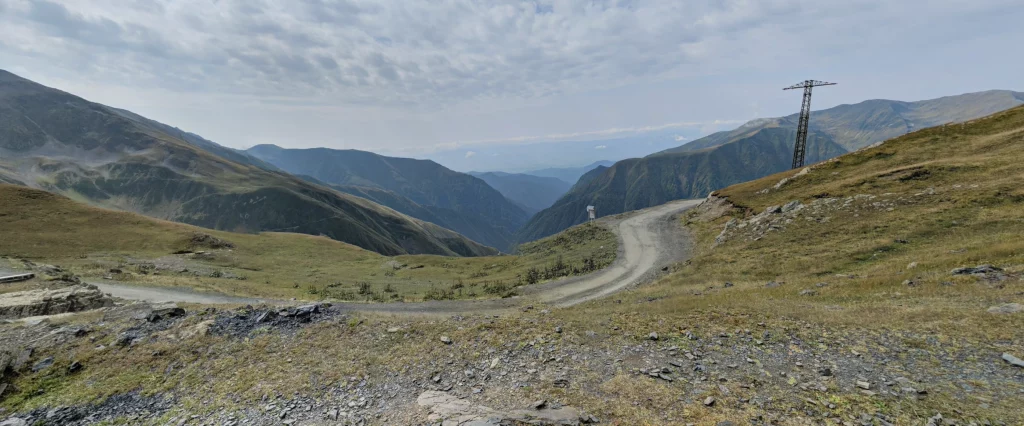
Tusheti… A magical word for adventure seekers. It is one of the most remote regions of Georgia, home to authentic mountain villages (Omalo, Dartlo, Bochorma, etc.), medieval towers, and untouched nature. Tusheti is called “the land where time stood still.” But it is also infamous for the road leading to this region. The only car road to Tusheti goes via Abano Pass (altitude ~2,900 m) and is officially recognized as one of the most dangerous in the world. Locals jokingly call it the “Road of Death.” It is a narrow serpentine carved into the rocks of the Greater Caucasus: on one side a sheer wall, on the other – a cliff hundreds of meters deep. There is neither asphalt nor guardrails. The surface consists of clay, stones, and gravel, which are washed away and collapse during rains. In some places, waterfalls flow directly across the road, eroding the ground under the wheels. Every year, people die there; along the road, makeshift memorials mark the spots where cars have fallen. Driving to Tusheti in a rental car is strictly prohibited. We even ask about your plans to continue past Kvemo Alvani (the last village before the ascent) – that’s how serious it is. The road is open only 4–5 months a year (roughly June to October); the rest of the time, Tusheti can be reached only by helicopter. Even when the pass is formally open, only highly experienced drivers in prepared 4×4 vehicles go there. Many tourists hire local Tushetian drivers – and rightly so. They know every turn, can pass on narrow stretches, and feel the car at the edge of slipping. A stranger without such skills venturing there is almost committing suicide. We’ve had clients beg for a jeep to go to Tusheti “at their own risk.” We always refuse – life and health are more valuable. Moreover, insurance companies explicitly exclude this road from coverage. If you venture there and damage the car, the policy will not pay a single tetri, and evacuation from Tusheti costs astronomical sums (if even possible). Think about it: it’s not worth it. If you dream of seeing sky-high Tusheti – please! But not behind the wheel of a rental car. First reach the villages of Pshaveli or Kvemo Alvani (the road there is asphalted), and then switch to transport operated by experienced local drivers. In season, UAZ “minibuses” regularly run from Alvani to Omalo; or order a jeep tour of Tusheti with a guide. Yes, it costs extra, but you will return safe, and the impressions will be joyful, without horror.
The Road to Shatili (Khevsureti Region)
The village of Shatili in Khevsureti is famous for its unique architectural ensemble – ancient defensive towers merged into a single stone fortress. It is a historical monument and a very picturesque place in a high-mountain valley on the border with Chechnya. You can reach it via the only road from the Mtskheta-Mtianeti region, through the Bear’s Cross Pass (Datvisjvari, ~2,676 m). Route: Tbilisi – Zhinvali – Barisakho – Shatili, about 150 km, half of which is dirt serpentine. Asphalt ends after the village of Gudani. From there to Shatili, the road is challenging: it first climbs steeply into the mountains, then winds along the ridge and descends into the Arguni river valley. The surface on this pass is very poor – large sharp stones, grader tracks, and deep ruts in places. The edges of Bear’s Cross Pass partially collapse into a ravine, making it difficult for two cars to pass. Any mistake can result in serious damage or a fall off the road. We forbid our cars from going beyond Gudani towards Shatili. A regular car cannot make it anyway, and attempts in crossovers have ended badly. For example, once tourists insisted they had an SUV and would “carefully drive through.” Result – a spring broke on the next pothole, and the car stopped at the top of the pass. No way forward or back. Locals managed to evacuate them, but the car required major repairs. Of course, no insurance covers such adventures. So again: do not drive to Shatili in a rental car. If you really want to go – fine, drive on asphalt to Gudani or even to the villages of Barisakho/Shatili (while the surface is still good). There are tourist centers there, and you can switch to prepared transport. Or take a tour from Tbilisi – there are now many one-day excursions to Shatili and the nearby village of Mutso in 4×4 vehicles. This way, you see the beauty of the ancient towers and sleep peacefully, without trembling at every turn of the Bear’s Trail.
Abkhazia and South Ossetia
Finally, let us separately mention the regions of Abkhazia and South Ossetia. Formally, they are within the internationally recognized territory of Georgia, but de facto are uncontrolled republics. Driving there in our car is strictly prohibited for political and legal reasons. First, no insurance applies in these territories, as they are frozen conflict zones. Any accident, theft, or car damage in Abkhazia or South Ossetia is your personal problem; the insurance company will not even consider the case. Second, entering there from the Georgian side is practically impossible legally. All official borders are closed: Georgian checkpoints will not let you pass. Some foreigners might theoretically enter Abkhazia from the Russian side, but that requires crossing the international border at the other end of the country, which violates the rental agreement (taking the car outside Georgia without permission). And even if you somehow manage to bring a rental car into Sukhumi or Tskhinvali, know that from the Georgian legal perspective, it’s illegal, and we immediately see the car missing via GPS and report it to the police. There have been cases where cars crossing into the conflict zone were confiscated by local “authorities,” and retrieving them later is nearly impossible. So, you risk both the car and your legal standing. We warn you in advance – do not attempt to drive to Abkhazia or South Ossetia in a rental car. If you want to see the Abkhazian coast, enter from the Russian side using your own transport or an organized tour, but definitely not with a car rented in Tbilisi or Batumi. As for South Ossetia – there is absolutely nothing for tourists there now; it is a closed military zone. Georgia has so many beautiful places that can be visited legally and safely that there is no reason to risk it for dubious adventures.
Conclusion: Plan Your Route Wisely
We have listed the main destinations where you should not drive a rental car. Some names may be new to you, others may be places you have been eager to visit. Trust us, we fully understand your curiosity: Georgia is full of hard-to-reach treasures that attract adventurers. However, our duty is to warn you about dangers and protect you from unnecessary risk. We have seen too many cases where ignoring these recommendations led to a ruined vacation, stress, and large expenses. So listen: if the rental company says “no” – it really means no. This is not out of greed or strictness, but out of concern for your safety and the protection of our property.
What if you really want to see mountain villages and wild parks? The answer is simple: choose alternative ways. Local 4×4 tours are well developed in Georgia – in almost every mountain village, you can find drivers ready to take you to hard-to-reach places in their vehicles for a reasonable fee. Many tour companies offer jeep tours to Tusheti, Khevsureti, Svaneti, Vashlovani Plateau, etc. This is an excellent option: you get to your destination without risking yourself or someone else’s car. Another option is to cover part of the way on foot (for example, walking through the Truso Gorge independently after the accessible part of the road). This “drive as far as possible, then walk or hire a local” combination often gives even more impressions than simply driving the whole way in your car.
In any case, plan your route in advance. When picking up the car, be sure to tell our managers where you intend to go. We will advise which roads are currently in good condition and where it is better to take a detour. And we will definitely warn you if your route is on the “blacklist.” Our goal is not to restrict your freedom but to help you plan your trip so it goes smoothly. Georgia is a hospitable and amazing country, and on good roads in your rental car, you can see dozens of wonderful places: from the wine valleys of Kakheti to the ski resorts of Gudauri, from the caves of Vardzia to the beaches of Adjara. Just consider the local infrastructure and follow our advice. Then your road trip in Georgia will be not only exciting but also safe. We wish you a pleasant journey and vivid impressions! GarmoniZ! (Which in Georgian means “Safe journey!”)