









29 min
Features of Mountain Switchbacks in Georgia
Georgia is a mountainous country, and winding switchback roads are common here. However, most popular routes have fairly good pavement and acceptable width. This means that major attractions are usually accessible via paved roads, where you don’t have to constantly reverse or “squeeze by” oncoming traffic, as is sometimes the case in other mountainous regions. Nevertheless, caution is advised: the mountainous terrain presents its own challenges—steep ascents and descents, narrow winding sections, and limited visibility around turns. Below we examine the most well-known mountainous routes and their characteristics:
Svaneti (Zugdidi – Mestia)
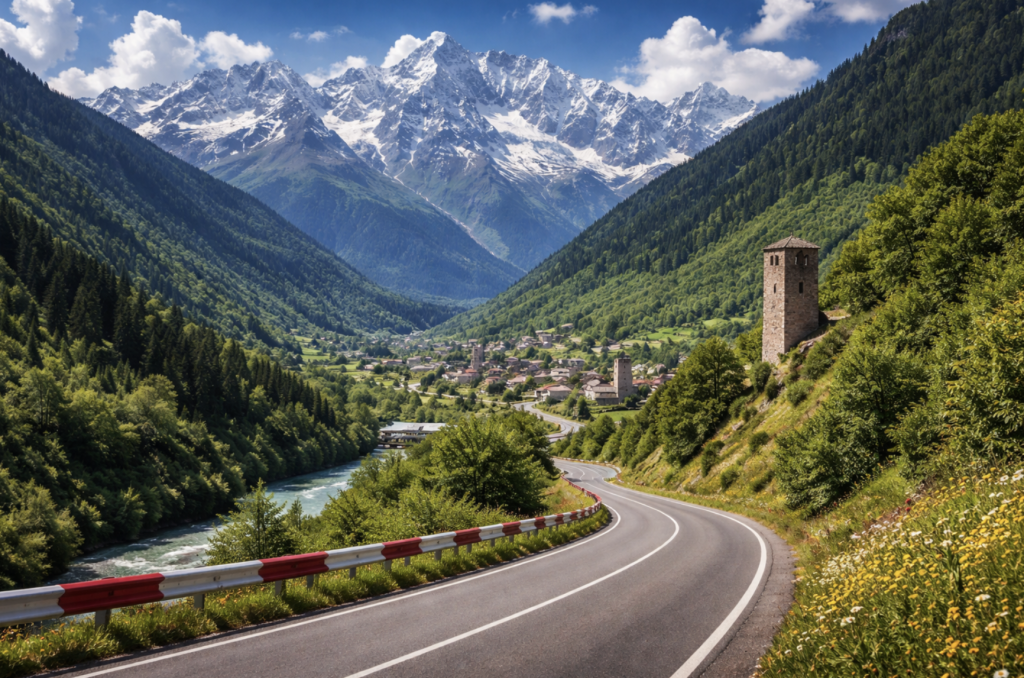
The road to Upper Svaneti is famous for both its beauty and difficulty. The stretch from Zugdidi to the village of Mestia (~130 km) is almost entirely a mountain switchback along the Inguri River. Covering this distance takes at least 4 hours, even though it looks short on the map. After the village of Jvari, the road begins steep curves and a continuous climb. The route has tunnels (about a dozen) and bridges, but also numerous sharp turns, ascents, and descents. In some sections, the road is narrow, with potential rockfalls and mudslides, especially in the off-season. This is a very picturesque route leading to highland villages with medieval towers, but drivers must remain extremely attentive. It’s no wonder the Zugdidi–Mestia road is considered one of the most beautiful and dangerous roads in the country.
Kazbegi (Military-Georgian Road)
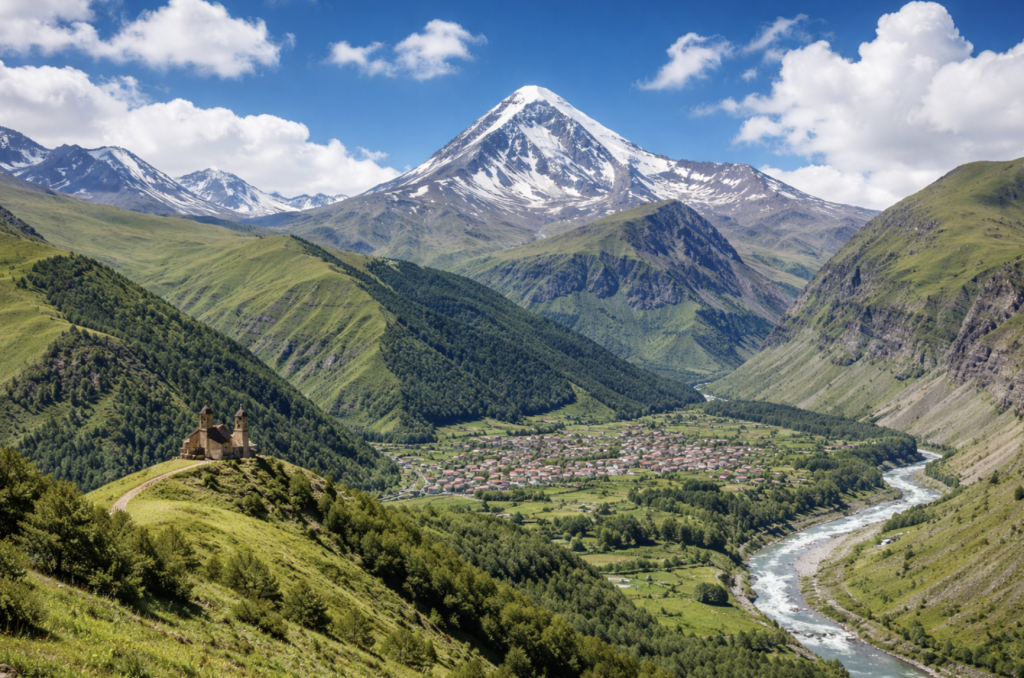
The route from Tbilisi through the Cross Pass to Mount Kazbek (town of Stepantsminda) is one of the most popular among tourists. The road passes through the Greater Caucasus Range, reaching an altitude of about 2,370 m at the pass. The Military-Georgian Road has an asphalt surface with one lane in each direction for most of its length. However, it is quite winding: in some places, the switchbacks are very sharp, with tight curves. Approaching the pass, there is a section called the “Mleta Descent”—a series of steep zigzags and loops. Extra caution is required in bad weather: fog, rain, or snow significantly complicate driving. Local drivers, familiar with the route, often drive quickly, making risky overtakes even on mountain turns. Tourists are advised to drive cautiously and follow the speed limit. Night driving on the pass is not recommended—you risk missing spectacular views and face greater stress due to limited visibility. If you are inexperienced in mountain driving, it is better to plan your pass during daylight. In winter, the pass may be temporarily closed due to snow or avalanche risk, so always check current conditions.
Western Georgia (Batumi – Kutaisi and Mountainous Adjara)
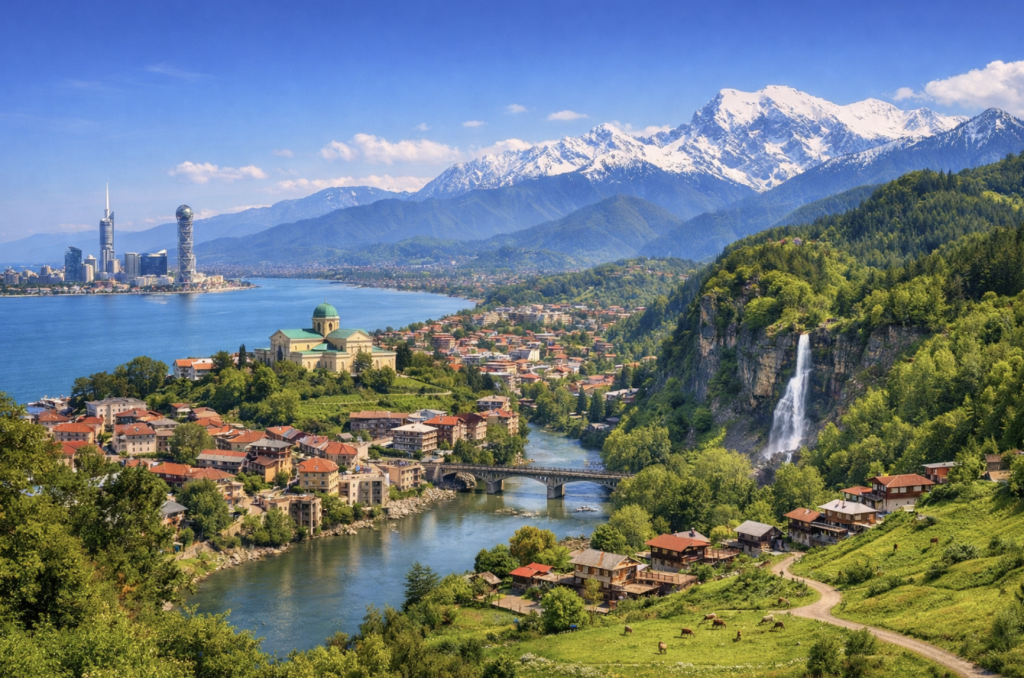
The main highway from Batumi to Kutaisi (via Zugdidi and Samtredia, part of the E60/E70 route) runs through lowlands and hills with a relatively gentle relief. This route is considered easy—it’s a standard two-lane road without extreme switchbacks. Pavement quality is good, and traffic can be busy, especially in summer. However, if you turn off the main highway into the Adjara mountains (for example, Batumi – Khulo – Akhaltsikhe via the Goderdzi Pass), you will encounter a challenging mountain switchback. The road there is narrow, with numerous hairpin turns, and in some places lacks reliable guardrails. The last 40 km to Batumi can take about an hour—the road becomes particularly winding near the final descent to the sea. Animals (cows, goats) often appear on these mountain roads, along with unexpected obstacles such as fallen rocks or streams crossing the road. Therefore, if taking alternative routes over mountain passes, be prepared for more extreme conditions. If you stay on the main roads between major cities, usually there are no special difficulties as long as you obey speed limits and stay attentive.
Despite the overall improvement of road conditions in Georgia in recent years, the driving style of locals may seem aggressive. Some drivers overtake on blind mountain curves and do not always follow rules, so foreign tourists must stay alert. Overall, driving on Georgian mountain roads is not frightening if you exercise caution. Many travelers report that with reasonable speed and careful driving, Georgia’s switchbacks are manageable even for drivers with average skills. The key is correctly assessing road conditions and your own capabilities.
Fundamentals of Safe Switchback Driving
The success of a trip on mountain switchbacks largely depends on following basic principles of safe driving. Below are key points to consider:
Speed and Driving Line
In the mountains, speeding is strictly prohibited—high speed on switchbacks can lead to loss of control. Always follow speed limits and reduce speed before every turn. Most mountain curves are blind, with zero visibility of oncoming lanes. Enter curves smoothly along the outside line and avoid “cutting” across lanes. Stay closer to the right edge of your lane, but do not drive onto the shoulder—it may be loose or nonexistent on mountain roads. Before a sharp bend, reduce speed enough to safely navigate without braking sharply within the curve. If you feel you are entering too fast, brake safely before the curve. Maintain a steady low speed through the curve, and only accelerate slightly after exiting. Always be prepared for potential hazards around bends: slow vehicles, animals, pedestrians, or fallen rocks.
Steering and Hand Position
On winding sections, hold the steering wheel with both hands at the “9 and 3 o’clock” position—this ensures maximum control. Make smooth steering movements without jerks. For very tight turns (almost 180° hairpins), you may need to reposition your hands—do so deliberately and in advance. Do not cross your hands excessively; work the wheel evenly. In emergencies (e.g., unexpected skidding), correct hand placement allows faster reaction and vehicle stabilization. Experienced drivers often wear thin gloves for better grip—hands may sweat in heat, and gloves prevent slipping. It’s not mandatory but useful for long mountain drives.
Following Distance
Keep an increased distance from the car ahead. In mountains, you cannot use the usual “city” distance—braking distances change unpredictably due to slopes and turns. If the vehicle in front brakes suddenly, you need enough space to stop safely. Increase distance also due to limited visibility: several cars may be ahead in a line, and a hazard (fallen rock, etc.) could appear two or three cars ahead—extra space gives time to react. Distance is especially important on descents: brakes heat up and lose efficiency, so extra space is your safeguard. On long ascents, do not follow closely behind slow vehicles; leave room for them to climb without pressure. If a car rolls backward while shifting on a slope (especially manual cars), distance prevents collision. Beginners in automatic cars should slow down and let the vehicle ahead complete the ascent before starting their own—safety is more important than saving a few minutes.
Overtaking on Mountain Roads
Overtaking on a switchback is the riskiest maneuver; avoid it if possible. On narrow one-lane roads, overtake only on well-visible straight sections where you are sure no oncoming vehicles are hundreds of meters ahead. If slow traffic (e.g., a truck) forms a line, wait for a legally allowed overtaking zone (marked by dashed lines and signs). Never overtake on a blind curve! Many locals risk overtaking on solid lines and blind bends—do not imitate this recklessness. Remember, rental cars do not have sports car dynamics, and you may be unfamiliar with road specifics. Better to lose a few minutes than risk a head-on collision. If a local driver aggressively tries to overtake, safely move to the right and let them pass; do not accelerate out of spite. Be aware that fast locals may flash lights, demanding right of way—remain calm, increase interval, and use the nearest turnout to let them pass safely.
Use of Horn
In mountains, it is considered appropriate to occasionally sound the horn before entering a blind sharp turn. This alerts oncoming drivers. Many Georgian drivers themselves honk on particularly tight curves—you can adopt this practice, especially when a warning sign “sound horn” appears. Do not overuse it, but signaling yourself in the mountains is useful. The horn can also scare off livestock (cows, horses) often found wandering on Georgian mountain roads.
Braking on Descents with Automatic Transmission
One of the main rules of mountain driving: use engine braking predominantly. This means downshifting on descents to let the engine slow the car rather than relying solely on the brake pedal. In a manual car, it is straightforward: shift to 2nd or even 1st gear at the start of the descent. But what about an automatic? Modern automatics also have modes suitable for mountains. Let’s examine engine braking techniques on an automatic and the available transmission modes:
- D (Drive) mode – standard driving mode. On normal flat roads, the automatic shifts gears up for fuel efficiency. On steep descents, D may shift to a higher gear, causing the car to accelerate downhill and require constant braking. A common mistake for beginners is staying in D the entire descent and using the brake constantly, which overheats brake discs and pads, reducing braking efficiency and risking failure. On long descents in D, engage manual or lower gears.
- L (Low), 2 or 3 mode. Many automatics have L (lowest gear) or numeric positions 1–3 limiting maximum gear. Use L or a lower gear on descents to prevent the transmission from upshifting and ensure consistent engine braking. On steep switchbacks, L keeps the car in 1st gear, controlling speed without brakes. In milder conditions, 2 allows shifting between 1st and 2nd gears. Some cars have S (Sport) mode—it keeps RPMs high and delays upshifts, useful on slopes.
- M (Manual) or +/- mode. Many modern automatics allow manual shifting (paddle or gear lever). This is very convenient in mountains: you select gears yourself. Switch to manual mode on switchbacks and choose lower gears on descents. For example, before a steep descent, shift “-” to 2nd or 1st gear—the car moves slower, reducing brake load. On ascents, you can hold a gear to prevent unnecessary shifting. Manual mode gives better control on slopes.
- Combined braking technique. Even with engine braking, you cannot entirely avoid the brakes. Correct approach: drive in lower gear and brake intermittently, avoiding prolonged pedal pressure. Never coast in neutral downhill—it’s dangerous and overheats brakes instantly. Keep a gear engaged; if speed rises, brake with short pulses, letting brakes cool. Continuous braking from top to bottom risks pedal fade and burnt smells—clear signs of brake overheating. Alternate engine braking and pedal to avoid this.
Why an automatic is convenient in mountains: for tourists unaccustomed to extreme driving, it reduces workload—no need for frequent shifting, allowing focus on steering and line. On long twisty ascents, automatics prevent stalling or rolling back—the torque converter ensures smooth hill starts. In busy resorts (e.g., Gudauri in summer), automatics are more comfortable—no fatigue from clutch use. Advantages: less stress for beginners, cannot select wrong gear, electronics prevent stalling mid-ascent.
Automatic limitations: must know how to use modes correctly. Driving “as on flat roads” without downshifting can overload brakes. Modern automatics (especially adaptive or Sport) often detect descents and hold gears, downshifting for assistance, but do not rely entirely—manual selection is safer. Also, transmission heat can rise during prolonged uphill driving in hot weather, but normally not critical if used properly.
In general, automatic transmissions are very convenient for tourists in mountains if used wisely. Many rental cars in Georgia are automatic, and thousands of travelers successfully navigate mountain routes following the rules above.
Seasonal Driving Features in the Mountains
Georgia’s mountain switchbacks require different skills depending on the season. Road conditions, weather, and traffic volume vary throughout the year. Below are the main seasonal factors:
Summer (June – August)
Summer is high tourist season. Traffic increases: minibuses, rental cars, off-road convoys. Narrow sections can be congested (roadworks or accidents). Plan early morning departures to avoid peak traffic, especially on popular routes like the Military-Georgian Road.
Temperature and vehicle load: daytime heat (up to +35 °C in lowlands; cooler but sunny in mountains) stresses engines and brakes. Long descents in heat increase brake overheating risk. Check brake response—if pedal feels soft or you smell burning, stop safely to cool down. High air temperature can also overheat engines on high-RPM climbs; check coolant and radiator before the trip. Cabin may be hot—ensure air conditioning or ventilation works, as opening windows on dusty mountain roads with wind is uncomfortable.
Mountain weather in summer: usually few rains, but thunderstorms occur. Heavy rain can wash roads with water and debris from slopes. Visibility drops, tires lose grip. In heavy rain, wait if possible; if driving, turn on low beams (or fog lights), keep even greater distance, and drive at minimal safe speed. Landslides are also possible in wet soil.
Tip: long summer days can make drivers complacent. Scenic views and relaxed passengers may distract. Do not look at landscapes while driving—one second can cause trouble. Stop at viewpoints to enjoy scenery. Always wear sunglasses—bright southern sun can blind you at critical moments on switchbacks.
Autumn (September – November)
Early autumn (Sept – early Oct) is favorable: cooler, fewer tourists, stable weather. Towards November, conditions become unpredictable: frequent rain, morning fog, first frosts in mountains.
Wet roads and leaves: fallen leaves are dangerous. After rain, wet leaves become slippery like ice. Tires lose grip, braking distance increases. Dry leaves hide potholes or wet spots. Reduce speed on leafy sections, avoid sharp maneuvers and braking.
Rain and mud: prolonged autumn rains can wash soil onto roads. Tires lose grip on wet asphalt—reduce speed below dry road limits. Rain with leaves worsens lane marking visibility. Use lights in fog or rain; stop if visibility drops below 50 m in a safe place.
Fog: Common in mountains in autumn. Entering a cloud may reduce visibility to a few meters. Use fog lights or low beams; never high beams. Drive in low gear, follow lane markings or roadside edge. GPS can help anticipate curves. Patience and minimal speed are essential. Fog is often local and clears after a few km or sunrise.
By late autumn (November), first snow may appear on high passes (Cross, Goderdzi, etc.). Night temperatures often drop below 0 °C. Be prepared for winter conditions—discussed below.