









31 min
Georgia is an ideal country for traveling by car: in a single day, you can manage to both ascend the mountains and descend to the sea. Our company has been helping tourists, expatriates, and business travelers rent a car and explore the country comfortably for many years. Below, we have compiled a detailed and up-to-date guide to renting a car in Georgia, taking into account the requirements and realities of 2024–2026. We will share professional advice based on real experience working with clients to ensure your road trip goes smoothly and safely.
Full Insurance: Types of Coverage and Pitfalls
When renting a car, be sure to pay attention to the terms of insurance. In Georgia, the rental price usually includes two types of insurance by default: mandatory civil liability (OSAGO) and basic comprehensive insurance (CASCO) with a deductible (uncovered portion of damage). OSAGO covers harm caused to third parties, while CASCO covers damage to the car itself, but often with limitations. Full insurance (Super CASCO) is an extended policy that covers 100% of damages, including wheel, glass, undercarriage, and other components typically excluded from basic coverage. We strongly recommend purchasing such extended insurance or initially choosing a plan with full insurance, especially if you plan long trips on mountain roads. Even experienced drivers find it difficult to predict the actions of other road users, and roads in an unfamiliar country can present surprises.
What does full insurance cover? Typically, it includes everything covered by standard insurance, plus it removes the client’s responsibility for any damage to the car – whether it’s an accident, scratches in a parking lot, or broken glass. The deductible with full insurance is minimal or zero, meaning you will not have to pay for repairs at all. For example, many of our clients choose the option “insurance with zero deductible” to avoid any out-of-pocket costs in the event of an accident. Full insurance also eliminates the need for a large deposit. However, it is important to read the contract carefully: some companies define “full” as covering only the body and main components, but not wheel or interior damage – these details are best clarified in advance when arranging the rental.
Pitfalls. Pay attention to exclusions: insurance does not apply if the driver was under the influence or violated the rental agreement (for example, drove onto a restricted area). It is also usually prohibited to drive off public roads – that is, off-road. If you decide to go off-road and damage the car, the insurance company may refuse coverage. From our experience: one client tried to cut a route along a dirt road and punctured a wheel – standard insurance did not cover this, and he had to pay for the tire replacement himself. Therefore, when going to mountain villages or hard-to-reach areas, make sure you either have a suitable vehicle (SUV), have the rental company’s permission for such trips, or purchase additional off-road insurance. In general, read the insurance terms and ask us about any unclear points – we will always clarify what is covered and what is not.
Deposit and Rental Conditions
Almost all companies require a security deposit – a refundable amount returned at the end of the rental if the car is in good condition. The deposit amount depends on the car class and insurance terms: on average, it is 300–600 GEL (Georgian lari) for standard cars. If you have full insurance without a deductible, the deposit may be lower or absent – many rental companies offer no-deposit rentals when extended insurance is purchased. Finding such options is easy: for example, we mark vehicles with the “No Deposit” option in our booking system.
Payment methods. The deposit can be left in cash or blocked on a card. Georgian rental companies are flexible regarding payment methods: they accept not only Visa/MasterCard credit cards but also ordinary debit cards. Some of our clients have even successfully used “Mir” cards. If you do not have an international bank card – no problem, you can pay cash in lari, dollars, or other convertible currency, and the deposit will be returned the same way. We usually accommodate clients and accept the deposit in a convenient form. Note that without funds for the deposit (or paid additional insurance), the car will most likely not be handed over – this is a standard precaution to cover potential damages.
Car handover and return. When receiving the car, carefully inspect it with our staff. All existing scratches and chips should be recorded in the handover act to avoid disputes later. From the moment the contract is signed, the responsibility for the car rests with you, so treat it carefully. The contract may include restrictions: for example, daily mileage (sometimes in budget rates, the limit can be 100 km per day or even 50 km, after which extra payment is charged per kilometer) – with us, mileage is usually unlimited, but this point should still be noted. Another condition is the territory of use: driving is usually allowed throughout Georgia; going abroad (to Armenia, Turkey, etc.) is possible only with company approval and additional paperwork. Violating these conditions (for example, unauthorized crossing of the border) may result in penalties by the rental company.
The car must be returned at the agreed time, with a full tank and clean interior. The tank should be refilled if you initially received the car full – this is the common Full-to-Full rule. If fuel is insufficient, we will charge for the missing fuel (often at an inflated rate) or request payment for refueling. Regarding cleanliness: smoking and transporting pets in the cabin are usually prohibited (or must be agreed separately) – deposits may be withheld for tobacco odor or heavy contamination requiring professional cleaning. Also, keep track of time: the minimum rental period is 24 hours; late returns of more than 1–2 hours may incur an additional day’s charge or a fixed late fee (usually ~15 GEL per hour). If you need to return the car in another city, arrange it in advance – intercity return is usually paid, but we often accommodate clients and provide a convenient option.
Additional services. Upon request, we provide a child seat, GPS navigator, Wi-Fi router, and other options. A child seat in Georgia is not only a matter of convenience but also traffic rules requirements (children under 12 must ride in restraint devices), so make sure to arrange this – we have seats of various categories. All extra services are specified in the contract: for example, an additional driver can operate the car only if their details are included in the contract (otherwise, insurance will not cover incidents involving them). We do not charge for a second driver, but some companies charge about 50–70 GEL for the entire rental period. Clarify these points in advance, and your trip will proceed without surprises.
New Traffic Rules (2024–2026)
Georgia’s traffic rules (TCR) are generally similar to European and Russian rules; however, in the past year or two, the government has introduced several important changes to enhance road safety. Here are the key updates for 2024–2026:
- Speed limits. Standard limits: 60 km/h in settlements (some central city areas have reduced limits of 50 or even 40), 90 km/h outside cities, and 110 km/h on highways. Newcomers may be surprised: speedometers may display miles instead of kilometers (cars from the USA or UK). Important change – from 2025, fines for exceeding speed by 15–40 km/h increased from 50 to 100 GEL. The officially allowed tolerance is 15 km/h – cameras do not issue fines below this threshold. Some drivers assume a 20 km/h buffer, but we do not recommend testing it. Better to follow the signs: highways increasingly have smart cameras measuring average speed over sections and will reliably issue fines for systematic speeding.
- Seat belts and child seats. All passengers and the driver must wear seat belts. Previously, the fine for an unfastened seat belt was 40 GEL, but from 2025 it increased to 50 GEL. This also applies to rear-seat passengers if belts are provided. Transporting children without a car seat or booster is also punishable by a fine of 40–50 GEL, and the police may stop you for such a violation. We strongly urge clients to ensure children’s safety – both for their health and to avoid legal issues.
- Mobile phone. Speaking while driving without a headset is prohibited. The fine for using a phone has increased to 50 GEL. Use hands-free or a headset, or stop if you need to answer an urgent call.
- Manoeuvring and road markings. Crossing solid lines, dangerous overtaking, and not following markings – fines are now stricter. From 2025, the fine for violating manoeuvring rules is increased to 100 GEL. Overtaking across a solid line or in a prohibited area may lead not only to fines but also to the loss of driver license points (Georgia has a points system; each violation deducts points, and license revocation occurs upon zero points). So do not imitate risky local driving. Incidentally, locals often signal with the horn before overtaking on mountain roads – it is considered good etiquette, meaning: “I am overtaking, please do not obstruct.” You can also do this on mountain roads to avoid misunderstandings.
- Parking and stopping. Cities have strict parking rules. Now, stopping on a pedestrian crossing or parking on the sidewalk is officially prohibited with a heavy fine – 100 GEL, and the car may be towed. Previously, fines for chaotic parking were symbolic, but in 2023–2024 in Tbilisi and other large cities (Batumi, Kutaisi, Mtskheta, Gori, etc.), fines for illegal parking increased to 50 GEL (in Tbilisi it was 10 GEL, now 50 GEL in regions by analogy). Therefore, park only in designated areas and follow “No Parking” signs. We will discuss paid parking below.
- Other: In 2024, new prohibitions were introduced. Tinted windows without special permission are now prohibited – fine 500 GEL instead of the previous 50. If you rent a car, it usually either has no heavy tinting or the company has permission. Loud exhausts are also targeted: from 2026, exceeding noise limits will result in a 100 GEL fine – consider this if renting a sports car. Drifting (intentional sliding) is prohibited under a separate article: fine from 300 to 500 GEL. And of course, driving under the influence: the permissible blood alcohol limit is 0.3‰ (approximately a glass of wine). Exceeding this limit results in immediate license revocation. Police actively catch drunk drivers; the fine is substantial (710 GEL or more), so do not drive after alcohol consumption.
In general, the new traffic rules aim to improve safety, as the number of cars on Georgian roads has increased sharply in recent years. We, in turn, also care about your trips: when issuing the car, we always remind you of key rules and updates as of your arrival date.
Fines and Photo/Video Enforcement: What and How to Pay
What can you be fined for? Common reasons for fines include speeding, parking violations, unfastened seat belts, phone use, running red lights, and more. As noted, fines have increased in recent years. For example, exceeding speed by 20 km/h now costs 100 GEL, by 40+ km/h – 300 GEL. Running a red light costs about 150 GEL, driving against traffic – about 200 GEL, driving in a dedicated bus lane in Tbilisi – 200 GEL. Parking in prohibited areas – 50 GEL, on a sidewalk or crossing – 100 GEL. Seat belt violation – 50 GEL, lack of child seat – 40 GEL. Separately, a fine for no insurance: all cars in Georgia must have OSAGO, and if, for some reason, you do not have it (theoretically in your own car), the fine is 50 GEL per day, up to 1000 GEL maximum. Fortunately, rental cars always have insurance, so this does not apply to you.
Surveillance cameras. Georgia is actively equipped with cameras. In cities, cameras monitor speed limits, stop lines, and bus lane violations at every step. On highways, there are radars and automatic enforcement systems, including average speed measurement over sections. Therefore, do not rely on “slipping through” – it is better to follow the rules. Note that cameras are not always visible. Often, warning signs are placed with speed limits (camera icon on a blue background). Many of our clients admitted that they were used to police leniency at home and initially received “speeding tickets” in Georgia. We immediately warn: follow the rules; enforcement is strict here. Road inspectors are also present, especially on busy roads and tourist areas.
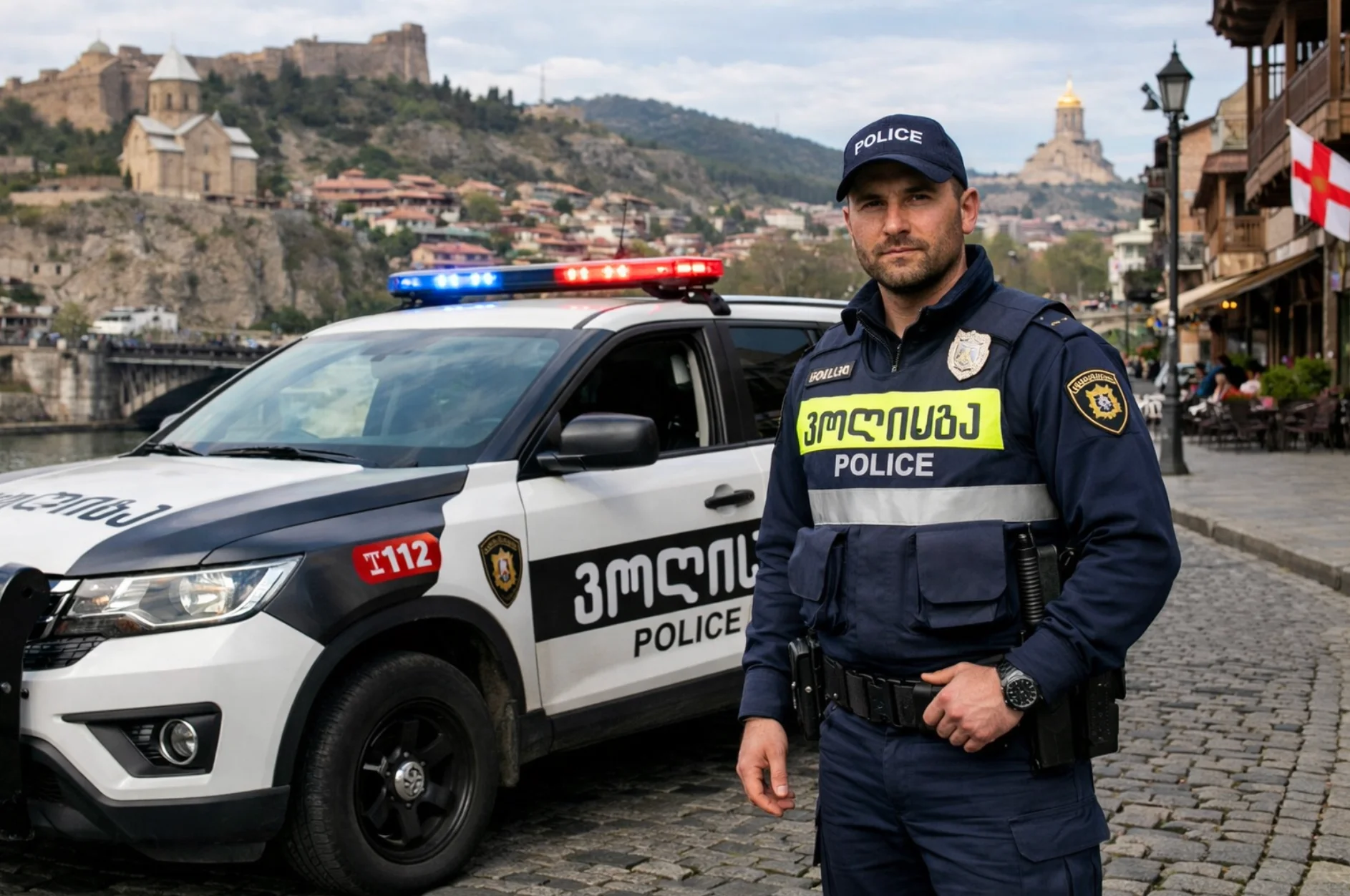
If you are stopped by a patrol, behave appropriately. Do not attempt to bribe (Georgian traffic police have nearly eliminated corruption, and attempting to negotiate may result in a serious fine). All interactions are recorded by dashcams, but officers are usually friendly toward foreigners. If there is a problem, contact the officers confidently. They willingly help tourists, give directions, or indicate the nearest service station.
Paying fines. It is important to know the payment procedure, especially if you violated camera-controlled rules. Fines in Georgia must be paid within 30 days. For automatic fines (camera-detected), a discount applies: if paid within the first 10 days, the amount is reduced by 20%. That is, pay sooner – pay less. You can check if there is a fine online via special services (for example, www.protocols.ge – by resolution number or vehicle registration). But it is easier to ask us, as we also track fines for rental cars. Often, notifications are sent via SMS (if the car has a Georgian owner number). In rentals, the notice is sent to our company as owner, and we inform the client. We usually proceed this way: minor fines up to ~50 GEL are requested to be paid in cash upon car return (or deducted from the deposit), while serious violations are processed officially – you can pay via bank receipt.
Payment methods. Fines can be paid in several ways: through bank payment terminals (e.g., TBC Pay, Bank of Georgia Express – orange and blue terminals are common in shopping centers and streets), at any bank branch, or online via websites like pay.ge or mobile applications of Georgian banks. The payment usually requires the resolution number (indicated in the receipt or SMS). For a foreigner without a Georgian account, it is easiest to go to a bank with a passport and paper – the cashier will help pay by fine number.
Leaving tomorrow? Do not worry: border checkpoints in Georgia also have cash desks or terminals where unpaid fines can be settled. So you will not be “stuck” in the country due to an unpaid fine. However, ignoring them is not recommended: first, information about debtors may affect future border crossings; second, the company may have to track you abroad for compensation – inconvenient for all parties. It is easier to follow speed limits and park correctly ????
Actions in Case of an Accident and Emergency Situations
No one plans accidents, but it is necessary to know what to do if something happens. First, remain calm. In Georgia, it is customary to call the patrol police in almost any accident, even minor scratches, especially if two cars are involved. Emergency number – 112 (unified for police, ambulance, fire). The operator usually speaks Georgian, Russian, and English and will explain what to do. If someone is injured – definitely call 112 immediately. If the accident is minor and there is no dispute over fault, some drivers agree to leave amicably, but we recommend waiting for the police so a protocol is issued. This is in your interest: the document is needed for insurance and prevents disputes.
After calling the police, contact us – our support line operates 24/7. We will send a representative if needed or advise by phone. Do not move the car until inspectors arrive if it obstructs traffic – place the warning triangle and turn on hazard lights. Police usually arrive quickly (in cities – within 10-30 minutes, in remote areas longer). Officers will inspect damages, question participants and witnesses, and issue a report. You will receive an accident certificate. Note: the protocol is in Georgian, but you can ask for clarification. Many Georgian officers speak Russian or English and will explain the content.
If you are not at fault, theoretically the responsible party should cover the damage to your car. However, in practice, you will not receive money on the spot, nor is it necessary: all repair coverage is handled through insurance. Never agree to “settle on the spot” with cash without a protocol – there have been cases when tourists accepted a few hundred lari from the responsible driver and released them, only to later find that the repair cost was higher, and insurance refused coverage without documents. Better to follow official procedures. If the other party tries to leave – remember or photograph their number and report to the police.
After accident processing, you continue your trip either with the same car (if damages are minor and safe to drive) or we provide a replacement vehicle. Such situations are rare, but we always keep a couple of reserve cars for emergencies for our clients. We can also assist with towing the damaged car if needed. All these services are covered by insurance if you follow the contract and traffic rules.
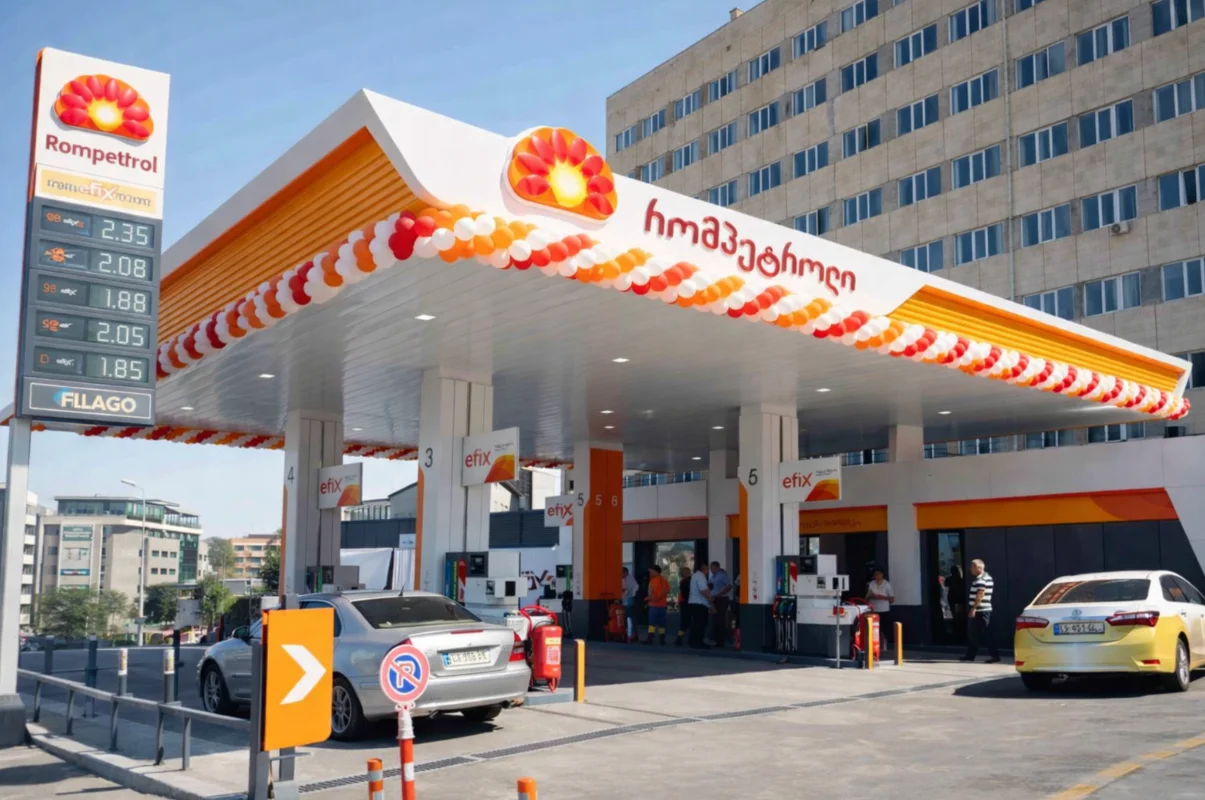
In emergencies unrelated to accidents – for example, breakdown on the road, flat tire, ran out of fuel – call us as well. We advise where the nearest service is or send roadside assistance. Regarding fuel: avoid letting the gauge fall below a quarter tank, especially in mountains where gas stations are sparse. Fuel in Georgia is of good quality (best to fill up at chain stations Socar, Gulf, Rompetrol), prices around 3.5–4.0 GEL per liter for gasoline and 3.0 GEL for diesel (prices fluctuate slightly). Payment for fuel – only in lari, by bank card or cash.
Our main recommendation: be attentive and cautious, minimizing the likelihood of accidents. But knowing the proper actions makes you feel more confident on unfamiliar roads.
Features of Car Rental in Tbilisi
The capital of Georgia is the starting point for most trips, and car rental in Tbilisi is the most in demand. Rental companies include both international aggregators (airport offices available) and dozens of local firms. For example, we are based in the city center but can deliver the car to the client for free – to the airport or hotel. In Tbilisi, it is easiest to find a car for every taste: from economical hatchbacks to all-wheel-drive SUVs. Prices in the capital range from ~70 GEL per day for a small car to 150+ GEL for an SUV (higher in peak season or short-term rentals).
City driving. Traffic in Tbilisi is heavy, especially during peak hours. Local drivers drive aggressively, like honking, and may cut in – initially unfamiliar for newcomers. Overall, the traffic situation is organized: traffic lights work, lane markings are clear, and signs are abundant. Be ready for hills – the city is hilly, with many narrow streets in old districts. Also, many one-way streets – a navigator is essential, or you may circle blocks. Fun fact: on the famous Heroes’ Square (large interchange), the traffic scheme is so complex that locals joke – first, you need to make a full circle to honor the heroes, then exit. One of our clients got lost there and missed their exit, had to circle again. It happens – just allow extra time for maneuvers downtown.
Experimental traffic solutions. Tbilisi authorities are introducing unusual traffic organization schemes. For example, on Chavchavadze Avenue, a dedicated bus lane runs in the center and against the main flow! It looks strange: the bus drives against traffic on its lane. Do not worry, you cannot enter it – just be aware of this. Reversible lanes have also been introduced on some main roads – follow the overhead signs indicating whether the lane is open or closed.
Parking. Almost all central Tbilisi parking is paid. The city has its own payment system – municipal parking is marked with blue lines or a P sign. Payment is possible via SMS, mobile app, parking meters, or special terminals (vehicle number and registration required). For visitors, this is inconvenient, so we provide a parking pass to our clients in Tbilisi: it allows leaving the car in city parking without payment during the rental period. If your company does not provide this option, you can buy a monthly parking ticket (about 50 GEL). The fine for unpaid parking is small – around 10 GEL plus time fee, but it’s better not to accumulate fines. In addition, for severe violations (parking in prohibited zones, bus lanes, sidewalks), the car may be towed. Towing costs around 50–80 GEL, plus a fine. You will have to collect the car from a special lot on the outskirts, which will disrupt your vacation plans.