












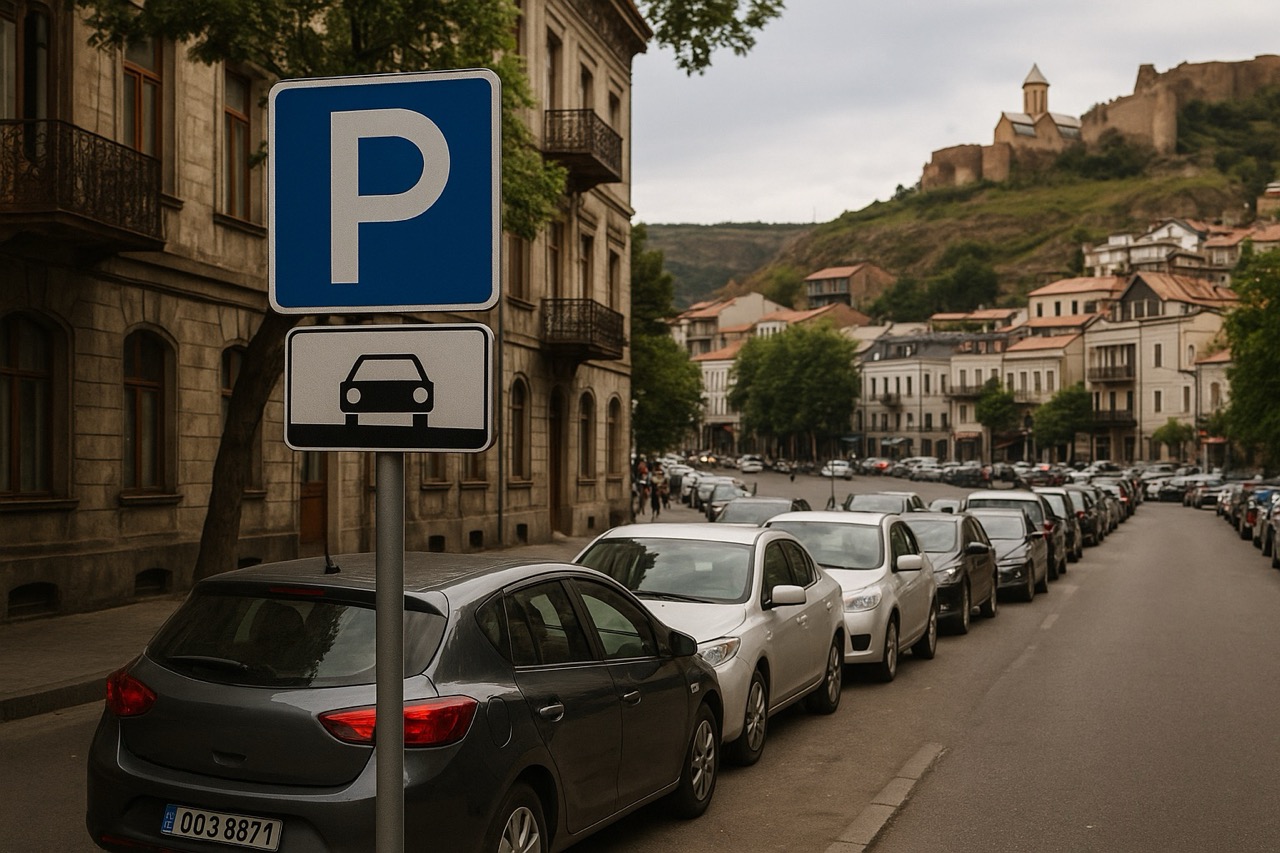
Parking space in Tbilisi’s historic districts is limited: narrow streets, popular tourist spots, and dense traffic. Nevertheless, drivers have access to a clear and understandable parking system; once you know how it works, you can enjoy your trip with confidence. The city center offers paid municipal street parking (marked by a blue “P” on signs) as well as several underground parking garages. As locals, we share all the nuances—from zonal parking tariffs to practical tips on where it’s best to leave your car. This is essential information for anyone planning to get around Tbilisi by car, whether it’s their own vehicle or a rental.
Imagine this: you’re leisurely driving a rental car through Tbilisi’s old quarters, with views of tiled rooftops and the Narikala Fortress opening up ahead. Soft music plays inside, the air conditioning saves you from the summer heat, and the navigator confidently guides you to the nearest available spot. One more moment—and you smoothly park in a cool underground garage, just steps away from bustling Rustaveli Avenue. With this freedom of movement and knowledge of parking rules, the city reveals itself in an entirely new way, giving you comfort and confidence behind the wheel.
Street (zonal) parking in the center: zones A, B, C and tariffs
The main part of central Tbilisi is covered by zonal hourly parking. This means that street parking in designated zones is paid during certain hours, and the cost depends on the location. In the historic center (for example, around Kote Abkhazi Street, the Old Town, and the Abanotubani area), three tariff zones apply:
- Zone A – 1 lari per hour (about $0.37).
- Zone B – 2 lari per hour (~$0.74).
- Zone C – 3 lari per hour (~$1.10).
The zone type and current rate are always shown on the information plate beneath the “P” sign on the specific street. The first 15 minutes of parking are free, intended for short stops such as dropping off passengers or running into a shop. If you plan to stay longer, be sure to pay for your parking time, otherwise you risk a fine. The fine for unpaid parking in Tbilisi is currently around 50 lari, and in serious cases the vehicle may even be towed. Not exactly a pleasant experience to return from a museum or restaurant and find your car gone!
How do you pay for parking?
It’s quite simple. First, there are parking meters and payment terminals (you’ll find them on streets with zonal parking, at gas stations, and in shops). At the terminal, you enter your vehicle’s license plate number (Georgian plates use Latin letters and numbers, in a format like AA777BB) and pay for the desired time. Second, there is the official Parking Tbilisi mobile app available for smartphones (App Store and Google Play). The app is convenient: it shows a map with all parking zones, allows you to pay quickly, and extend your parking if needed. However, note one nuance: registration in the app often requires a Georgian bank card or phone number. If you’re visiting briefly and don’t have a local card, it’s easier to use a payment terminal or ask locals for help—Georgians are very friendly and happy to assist. By the way, the Parking Tbilisi website (parking.tbilisi.gov.ge) also allows online payment and can be used via a translator.
After payment, there is no need to leave a receipt on the dashboard—the system links payment to the license plate electronically. Parking inspectors check by plate number whether the spot has been paid. If your time is about to expire, it’s best to return to the car or extend the parking remotely to avoid a fine. Towing services operate in the city: for violations or non-payment, a car may be towed, and you’ll have to pay around 50–150 lari for the full “package” (fine, towing, and storage).
When is parking free?
Payment is required only in designated paid areas (zones) and usually only during daytime hours—the exact schedule is shown on the sign. Outside operating hours (for example, late at night or on weekends, if indicated on the sign), street parking may be free. You also don’t need to pay where there are no paid parking signs—elsewhere in Tbilisi, parking is free. Many locals, for example, park in courtyards or along streets outside the center. We don’t recommend tourists park chaotically on sidewalks or in unauthorized places—although some people do, you may receive a fine or have your car towed if you’re unlucky. It’s better to follow the rules: look for markings, the “P” sign, and follow posted instructions.
Parking permits
If you plan to stay in Tbilisi for a longer time or drive across different districts, there’s a convenient option—a parking permit. For 50 lari, you can purchase a permit valid for an entire year and park at any municipal parking areas outside zones A, B, and C. Shorter permits are also available: weekly (~4–5 lari) or monthly. Keep in mind, however, that a permit does not exempt you from hourly payment in the central zones. It covers only areas of the city without zonal tariffs. For example, with a permit you can park for free on the outskirts or in residential districts, but in the very center (A, B, C) you still pay hourly. A permit is useful if, for instance, you’ve booked accommodation outside the main tourist hub and plan to drive around the city. Permits can be purchased via the app or terminals by selecting the desired period.
Parking attendants in vests
A feature of Georgian cities is the presence of so-called volunteer parking attendants. In Tbilisi, you may encounter men in bright vests with batons who wave you in, helping you squeeze into a tight space. Officially, these people do not collect parking fees (parking payments are made only through the methods described above); their help is voluntary. It’s customary to thank such a helper with a small tip of 1–2 lari after a successful parking maneuver. But remember: this is not mandatory, just a gesture of courtesy. If a “parking attendant” behaves aggressively or demands money, feel free to refuse—you are not legally obliged to pay. Such situations are rare, though—more often they genuinely help with gestures or keep an eye on the car while you’re away, hoping for a small reward.
Underground parking in the center: where to leave your car comfortably
The historic center of Tbilisi attracts many tourists, so the authorities have equipped several underground parking facilities. They’re convenient if you want to protect your car from heat, avoid circling streets looking for a spot, or leave the vehicle for an extended time. Here are the most popular and convenient locations in the central part of the city:
- Freedom Square underground parking. This is perhaps the main parking facility in the heart of Tbilisi—directly beneath Freedom Square (formerly Lenin Square). The entrance is from Pushkin Street and Rustaveli Avenue. The garage is large, guarded, and open 24/7. From here, it’s just a short walk to the Old Town, Rustaveli Avenue, and Galleria Tbilisi shopping mall. If you’re staying in a hotel or apartment in Sololaki or near Freedom Square, this is the best option. Payment is calculated per minute at the exit via an automated machine (cash or card). Rates are moderate, around 2–3 lari per hour, with daily options available. Tip: in the evenings and on weekends, Freedom Square can be busy, but there’s almost always space underground.
- Parking near Rike Park (Europe Square). On the left bank of the Kura River, next to Rike Park and the lower station of the cable car to Narikala, there’s another large underground parking garage. It’s extremely convenient for exploring the Old Town: ride the cable car up to the fortress, stroll through the park, or walk across the Bridge of Peace. You can leave your car right by the park entrance, descending underground. Many travelers note its affordable price—around 7 lari per day. For a symbolic fee, you get a safe space and peace of mind with camera surveillance. Like others, the Rike parking has barriers: take a ticket on entry and pay at the machine when exiting. If you plan a long walk through the center, this is an excellent choice.
- Orbeliani Square parking. A small modern underground garage located beneath the renovated Orbeliani Square (near Rustaveli Avenue, close to the Flower Market and the city court). Built recently as part of a district renewal, it accommodates about 150 cars. The entrance is from Anton Purtseladze Street. Its main advantage is proximity to the Dry Bridge area (flea market), the Griboedov Academic Theatre, and the lower part of Rustaveli Avenue. It’s convenient if you’re visiting the Dry Bridge flea market or walking around the Vera district. The parking is paid, with rates comparable to others (about 1–2 lari per hour). Note that in the evenings, Orbeliani Square itself may be closed to traffic for pedestrian events, but vehicle access to the garage remains via side streets.
- Shopping centers and hotels. You can also use covered parking at shopping malls. For example, Galleria Tbilisi on Shota Rustaveli Avenue has its own multi-level underground parking (entrance from Lesia Ukrainka Street). It’s primarily for mall visitors but effectively open to everyone for hourly payment. If you need a short stop in this part of the center, it’s a practical option: the first hour costs around 2 lari, with increasing rates afterward, or free with purchases during promotions. Another mall, Shopping Mall “Gallery” near the avenue, also has parking. Many major hotels (Marriott, Radisson, etc.) offer their own guarded parking for guests—check when booking. Keep in mind, however: “free hotel parking” often means standard city spaces outside the building. If the hotel is in a paid parking zone, you’ll still need to pay the municipal fee unless it has a truly private fenced area or underground garage.
Overall, underground parking in central Tbilisi is your best friend if you value comfort and safety. These garages are guarded, usually operate 24/7, and protect your car from the elements. In summer, the sun can be relentless, but underground your car stays cool. In winter, you won’t need to scrape frost off the windows in the morning. Plus, you won’t worry about towing or someone bumping your car on a tight street.
Small tips from a local driver
- Look for free spots slightly away from the center. In the tourist core, finding free parking is nearly impossible, but just outside these zones, your chances improve. For example, near the famous Bridge of Peace along the embankment, there’s a small free parking area. Early in the morning or late in the evening, you can often find a spot there and walk to the Old Town. Free pockets also appear in courtyards and near residential buildings just beyond paid zones. If you don’t mind a 5–10 minute walk, you can save money—just make sure there are no prohibitive signs or markings.
- Protect your car from the sun. Tbilisi is a sunny city, and in summer temperatures often exceed +35 °C. If you leave your car in the open, the interior heats up quickly. For daytime parking, choose shade or an underground garage. A handy tip: carry a sunshade for the windshield—it’s inexpensive but significantly reduces interior heat while you’re out exploring.
- Pay close attention to markings and signs. The historic center has many confusing one-way streets and stopping restrictions. Before leaving your car, make sure the markings allow parking (a white dashed line along the curb) and that there are no “no parking” signs or reserved spots. Sometimes a place looks permissible, but a sign just a few meters away prohibits stopping—don’t miss it.
- Don’t leave valuables in plain sight. A universal rule, but worth repeating. Tbilisi is generally safe, but any large city has some risk of car break-ins. At night, it’s best to clear the interior of bags, navigators, and other items, especially if parking in a courtyard or on the street. If possible, take valuables with you to the hotel.
- Keep local driving habits in mind. Local drivers park skillfully and sometimes squeeze cars into very tight “gaps,” using minimal space. Be prepared to find your car tightly boxed in the morning. Often it’s enough to leave the car in neutral and not fully engage the handbrake—then it can be shifted manually if needed, as practiced on narrow streets (yes, in Tbilisi, cars parked in gear may be pushed—this does happen!). Still, it’s better to choose more spacious parking areas and avoid creating obstacles yourself.
Why renting a car is convenient (even with parking nuances)
Despite the need to understand parking rules, traveling around Tbilisi by car is one of the best choices for a curious visitor. A car gives you route freedom: in the morning you can drive to the Jvari Monastery near Mtskheta, return for lunch in lively Mtatsminda, and in the evening head to Turtle Lake to watch the sunset. Without your own transport, fitting so much into one day is nearly impossible.
The parking system, as we’ve seen, is fairly clear and civilized—with a bit of practice, you’ll quickly learn to navigate signs and zones. As a local guide and car enthusiast, I can say: choosing the right vehicle greatly simplifies parking. For narrow Old Town streets, compact models are ideal. A small city hatchback or sedan (such as Volkswagen Passat or BMW 750) is easier to fit between balconies and curbs. On the other hand, if you plan trips outside the city—into mountains, villages, or rougher roads—it’s worth considering crossovers or SUVs. These vehicles are taller and more powerful (for example, Toyota Land Cruiser Prado or Range Rover Vogue 4.4 Diesel (Autobiography) Black), letting you drive confidently even toward Kazbegi without worrying about potholes—though you’ll need more space to park in the center. Our rental fleet includes options for every taste: from nimble, economical compact cars to prestigious all-wheel-drive SUVs. All vehicles are equipped with air conditioning (and many with rear-view cameras and parking sensors, which are especially helpful in an unfamiliar city).
When you rent a car from our company, you receive not only a vehicle but also the support of local experts. We’re happy to advise you on where to park near your hotel or destination and explain payment details. If needed, we can even arrange parking permits for your stay so you don’t waste time. We value our guests’ comfort: all cars undergo regular inspections, are clean, fueled, and ready for any trip. All that’s left for you is to enjoy the road.
Tbilisi is a welcoming city, perfectly suited for car-based exploration. Yes, the city center demands attentiveness from drivers—but now you know all the key nuances. Park properly and explore the city on wheels with confidence! Your car will always be nearby, ready to take you to new discoveries across Georgia. We’ll make sure that both rental and parking are as convenient as possible, and that your travel impressions are nothing but positive. Welcome to Tbilisi and safe travels!

