








Гнедько Марина, Автор в Cabrio - Page 4 of 5 | CabrioGE

How to Plan a Winter Trip to Gudauri with a Rental Car

Features of the Winter Route Tbilisi – Gudauri (Military-Georgian Road)

The route from Tbilisi to Gudauri runs along the famous Military-Georgian Road via the Cross Pass. This highway climbs high into the mountains – the elevation change is about 1,800 meters. The road is a mountain serpentine: many turns and stretches without guardrails, requiring careful attention. In winter, the surface may be snowy or icy. Although the highway is regularly cleared among the first, driving can still be challenging.

During peak season (December – March), traffic increases: tourists heading to the resort and trucks traveling to the border share the road. Allow extra travel time – the usual ~2–2.5 hours from Tbilisi can increase to 3–4 hours under winter conditions. In extreme cases (avalanches, closures), the journey can take 6–8 hours. Plan your departure with a time buffer and note that after heavy snowfall, the pass may be temporarily closed due to snow or wind. Information on road restrictions is usually available in news reports and Ministry of Emergency Situations updates.

Preparing Your Car for Winter Roads

Before heading into the mountains, make sure your vehicle is fully prepared for winter conditions.

Tires: good tires are essential on steep road sections. From December, winter tires (snowflake-marked, tread ≥3 mm) are mandatory on the Mleta – Kobi section of the Military-Georgian Road. Check that your car is equipped with winter tires; if not, request a tire change from the rental company. When renting a car from us, you can be sure the vehicle comes with winter tires. We prepare our cars for the season and mountain conditions in advance.

Snow Chains are also recommended – some challenging sections in severe ice conditions are passable only with chains (police may stop you and require chains during worsening weather).

Brakes: descending from the pass requires fully functional brakes. Check the brake fluid level and braking efficiency, and if in doubt, ask the rental service to inspect them.

Fuel: always start with a full tank. Your rental car is provided with fuel, but make sure it is actually full and refuel in Tbilisi before the ascent. Gas stations beyond the capital are sparse – around Gudauri and Stepantsminda, fueling options are limited, so it’s best to have enough fuel for the round trip.

Windshield washer fluid: fill with antifreeze fluid and check wiper functionality. Mountain roads are often covered with snow and de-icing chemicals, which can dirty the windshield – a supply of washer fluid is essential for safe visibility. Also, ensure your windshield and mirror heaters are working – temperatures at night drop sharply, and ice forms quickly.

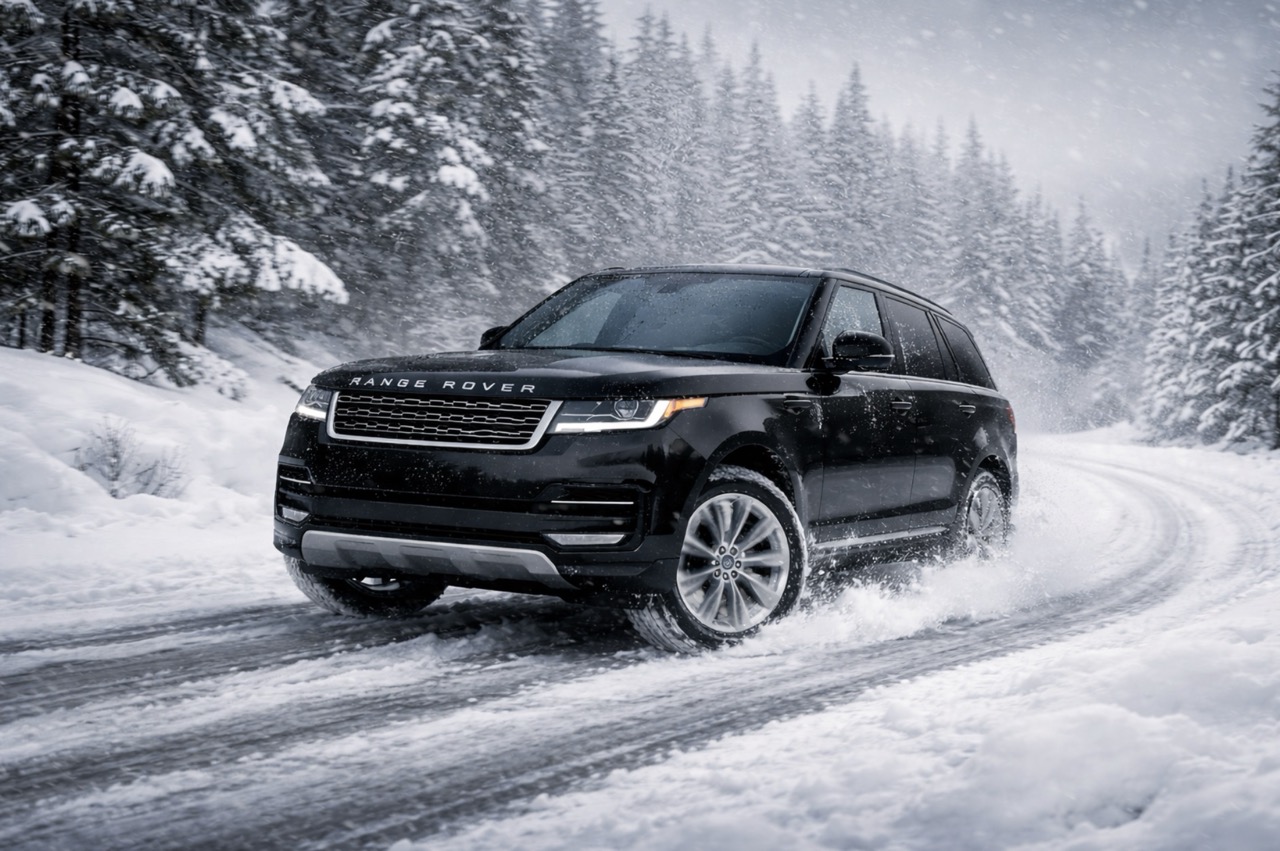
Tip: if possible, choose a higher-class vehicle for winter travel. All-wheel drive or a crossover provides more confidence on the pass. Even on cleared asphalt, a powerful SUV is more stable on climbs and descents. For a standard sedan, pay close attention to road conditions and speed – on steep serpentine roads, especially in snowfall, high ground clearance and all-wheel drive make driving significantly easier.

Additional Options: When and Why to Request

Rental cars come with insurance and basic amenities, but a range of additional options can make your winter trip more comfortable and safer. All necessary accessories are available from the rental company – you just need to request them during booking or in advance. Here are key options and their benefits:

  • Snow Chains: the main winter option for mountain roads. Request chains mandatory if planning to climb the pass after heavy snowfall or in icy conditions. Even with winter tires, chains provide extra traction on particularly steep or icy stretches. In Georgia, chains are often required on challenging winter road sections, and rentals usually provide them on request. Better to have them and not need them than to face a slippery section without chains.
  • Ski Rack / Thule Box: if you are going skiing, indicate the need for a roof ski rack or cargo box when booking. This allows you to store skis, snowboards, or bulky winter gear safely. Otherwise, you may have to cram equipment inside the cabin, which is inconvenient and potentially unsafe. A dedicated ski and snowboard rack or branded box (e.g., Thule) secures your equipment and keeps passenger space free.
  • Wi-Fi Router: useful for those needing constant connectivity or remote work on the road. Mobile Wi-Fi allows passengers to use the internet and the driver to access weather updates, traffic, and pass status online. Mountain connectivity can be spotty, so a router with a local SIM card (usually offered by the rental) ensures internet on the move. If planning to work or share navigation with your group, request a Wi-Fi modem in advance.
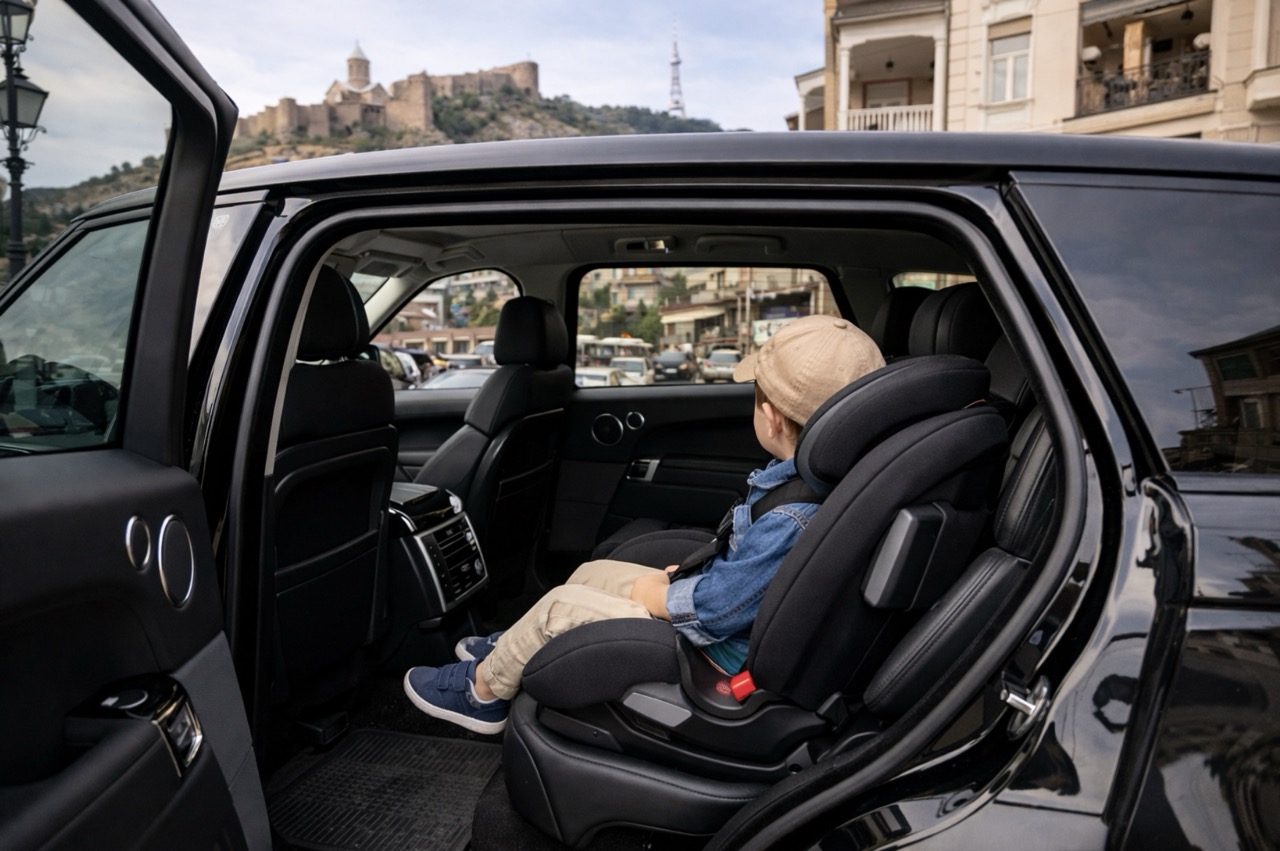
  • Child Seats: required for families with children. Georgian law requires children under 12 to ride only in the back seat, and infants under ~3 years in a special restraint. Even if some flexibility exists, child safety comes first. Rental companies provide seats for a small fee – indicate children’s ages during booking. Check the seat’s attachment before departure.
  • Additional Driver: long mountain drives in snow are demanding. If traveling with a companion, add a second driver option. This allows shifts at the wheel and prevents fatigue. Especially useful for less experienced winter drivers – responsibilities can be shared, giving each a rest. Legally, only drivers listed in the contract may operate the car, so add the second driver in advance (usually a small additional fee).

Note that some additional options incur extra charges, so confirm availability in advance. Plan which options you need and include them in the booking – this ensures your car is prepared accordingly and saves time at pickup.

Winter Driving in the Mountains

As you approach the ski resort, road conditions can deteriorate rapidly. Here are practical tips for winter driving:

Speed: drive slowly and smoothly on snow and ice. Sudden acceleration or braking is dangerous – the car may skid. Recommended not to exceed ~80 km/h even on cleared sections. On steep serpentine curves, speed should be lower. Remember: it’s better to spend an extra hour than risk an accident – any mistake in these conditions can have serious consequences.

Distance: maintain a following distance several times greater than usual. Braking distance increases dramatically on slippery roads. Experienced drivers recommend up to 10 times the normal distance in winter. Practically, keep a 5–6 second interval behind the vehicle ahead. This buffer gives time to react if someone skids or brakes suddenly.

Braking: use engine braking on descents and icy stretches. Shift to a lower gear early, so the car slows without hard brake application. For automatic transmission, use manual mode (e.g., 2nd or 3rd gear, or “L” – Low). Driving in third gear during snowfall is optimal: the car starts smoothly and brakes effectively using the engine. Use the brake pedal gently with short presses. If equipped with ABS, press firmly and do not release during emergency braking – pulsation is normal. Stay calm: electronic systems help you stop safely on slippery surfaces.

Turns and maneuvers: when entering a turn on snow, lift off the accelerator and negotiate the curve in a lower gear without sharp steering. Avoid overtaking on serpentine roads – shoulders may hide ice or snowbanks. Remember: overtaking on icy roads is a last resort. Better to follow slower traffic than risk losing control. If the car begins to skid (rear end slides), do not brake – steer gently into the skid and ease off the accelerator to regain control.

Challenging sections: be extra cautious on bridges, shaded areas, and after tunnels. Bridges and overpasses freeze first; cross slowly and avoid lane changes. Ice often forms after tunnels due to temperature differences. Approaching the pass, galleries (avalanche protection tunnels) may leave the road snow-covered immediately after exit. Keep a firm grip on the steering wheel as gusts or snow drifts can push the car off course.

Time of Day and Weather Considerations

Time of day: plan your ascent to Gudauri during daylight. Night driving in the mountains involves multiple risks: almost zero visibility in snowfall or fog, wildlife crossing the road, and sharp temperature drops causing ice. Daylight offers better conditions: sun (if present) melts snow slightly, snowplows clear the road, and main icy sections are treated with de-icing agents. Also, daytime driving allows visual assessment of road conditions and enjoyment of the mountain scenery. Avoid night travel through the pass unless absolutely necessary. If delayed, it’s better to overnight at lower elevation and depart at sunrise.

Weather: check the forecast before departure. Mountain weather changes quickly – sunny one moment, stormy the next. Snowfall: exercise extra caution or postpone travel during heavy snow. Georgian road crews typically clear roads within hours after a storm. If unusually heavy snow (>1 m at once) falls, roads may not be cleared immediately. Historically, snowdrifts and avalanches near Mleta have made the road to Gudauri impassable for several days. Fog: common at the pass. Use fog lights (if available) or low beams, reduce speed, and follow road markings or tunnel walls for guidance. Avoid high beams – they reduce visibility in fog. Blizzards and strong winds: open sections (Cross Pass, before Kobi) can experience hurricane-force gusts. Winds may push vehicles off course and form snow drifts. If a blizzard starts, wait in a safe spot (gas station, police post, or roadside café) rather than risk driving.

Pass closures: be prepared for authorities to close the Cross Pass during extreme weather for safety or clearing. This can happen after heavy snow, avalanche threats, or immediately after an avalanche – clearing takes time. During closures, access to Gudauri from any side is blocked by police checkpoints. Predicting closures in advance is difficult – it depends on weather. Monitor updates: road status can be checked via news sites, tourist hotlines, or your rental company. Tourist hotline in Georgia: 1441 (support in Russian, English, and Georgian).

If you are already en route and learn the pass is closed, do not continue ascending. Stop at the nearest settlement until conditions improve. For example, wait in villages lower on the slope (Pasanauri, Ananuri) or return to Mtskheta/Tbilisi with hotels available. Restrictions usually last 1–2 days, rarely over a week. Keep a thermos with hot tea, water, and snacks in case you are stuck or waiting. A warm blanket or extra clothing is also useful – mountain temperatures in winter can drop to -15…-20°C, and a parked car gets cold quickly.

Emergency Actions

We hope your journey goes smoothly, but in the mountains, be prepared for unexpected situations. Good news: renting from a reliable company provides 24/7 road support. If your car breaks down, gets stuck, or there is an incident – contact the rental support service immediately. Most Georgian rental companies offer 24/7 roadside assistance: staff promptly consult and dispatch help. Add the support number from your rental contract to your phone and keep it charged during the trip.

For serious incidents (accidents with injuries, major breakdowns at night, etc.) – call the emergency number 112. In Georgia, 112 is available 24/7 from mobile or landline, connecting to fire, ambulance, or police as needed. Clearly explain the situation and your location (milestone numbers on the Military-Georgian Road or the nearest village).

Useful contacts to have: 112 (emergency), rental company support number, backup contact for the rental office or manager, and your insurance company if you have extended coverage. Many rentals provide basic insurance, but Super CASCO (full coverage) is usually an extra option. Confirm your coverage and procedures for accidents – whether to wait for police. Normally, rental support staff guide all steps and may assist with translation when communicating with local authorities.

If your car is stuck in snow on the approach (e.g., shoulder or uncleared parking), do not try to force it out – you may dig in deeper. Instead, call our support; we can dispatch assistance or guide you to the nearest tractor or jeep that can pull the car out. In Gudauri and nearby, locals can help for a fee, but coordinate through the rental company first. Remember, your rental includes roadside assistance, so use it.

Alternative Plan in Bad Weather

Sometimes the best decision is not to drive if the road is dangerous. During heavy snow or pass closure notifications, it is wise to adjust plans. Alternative routes are limited (the only way to Gudauri is via Cross Pass), so the main option is postpone the trip until conditions improve. If already leaving Tbilisi and facing problems on the pass, consider:

  • Overnight stop along the way. Instead of risking the road, find a hotel or guesthouse nearby. For example, Pasanauri (about 70 km from Tbilisi) has several accommodations; options exist in Gudauri or lower along the road. Overnight and depart in the morning – roads may be cleared overnight, and conditions improve.
  • Return to a safe zone. If you’ve climbed high and face a blizzard or traffic jam ahead, it may be better to descend to lower altitudes (where there is no snow) and wait. Descend, for instance, to Ananuri or near the Jinvali Reservoir – lower, warmer, with cafes and gas stations. Wait until authorities confirm the road is open.
  • Change your travel route. In extreme cases, if the forecast is unfavorable for the next days, consider alternative destinations. Georgia has other ski resorts (Bakuriani, Goderdzi), or you can explore Tbilisi and surrounding attractions, postponing Gudauri for later. This is a Plan B, but safety is more important than sticking rigidly to the original plan.

Remember: in the mountains, the ultimate dictator is the weather. Experienced travelers always leave room for flexibility in their schedule. Keep an eye on weather reports, ask locals for advice (in Georgia, people are usually happy to provide up-to-date information), and don’t hesitate to decide to stop if conditions worsen. Your rental car won’t go anywhere – it’s better to arrive later safely than risk an adventure. Rental companies usually accommodate extensions in case of force majeure or if you need to adjust your schedule (check the terms; many offer a one-day extension at a discounted rate during bad weather).

The winter road to Gudauri is a challenge that requires both technical preparation and mental readiness. Plan your route taking mountain realities into account, check your vehicle, equip it with the necessary options, and strictly follow safe driving rules. By doing so, your journey will go smoothly, and you’ll be able to fully enjoy the beauty of the Caucasus Mountains without unnecessary worries. Wishing you a safe trip and soft snow!
Flight Delay: How to Reschedule Your Rental Car Pick-Up Time

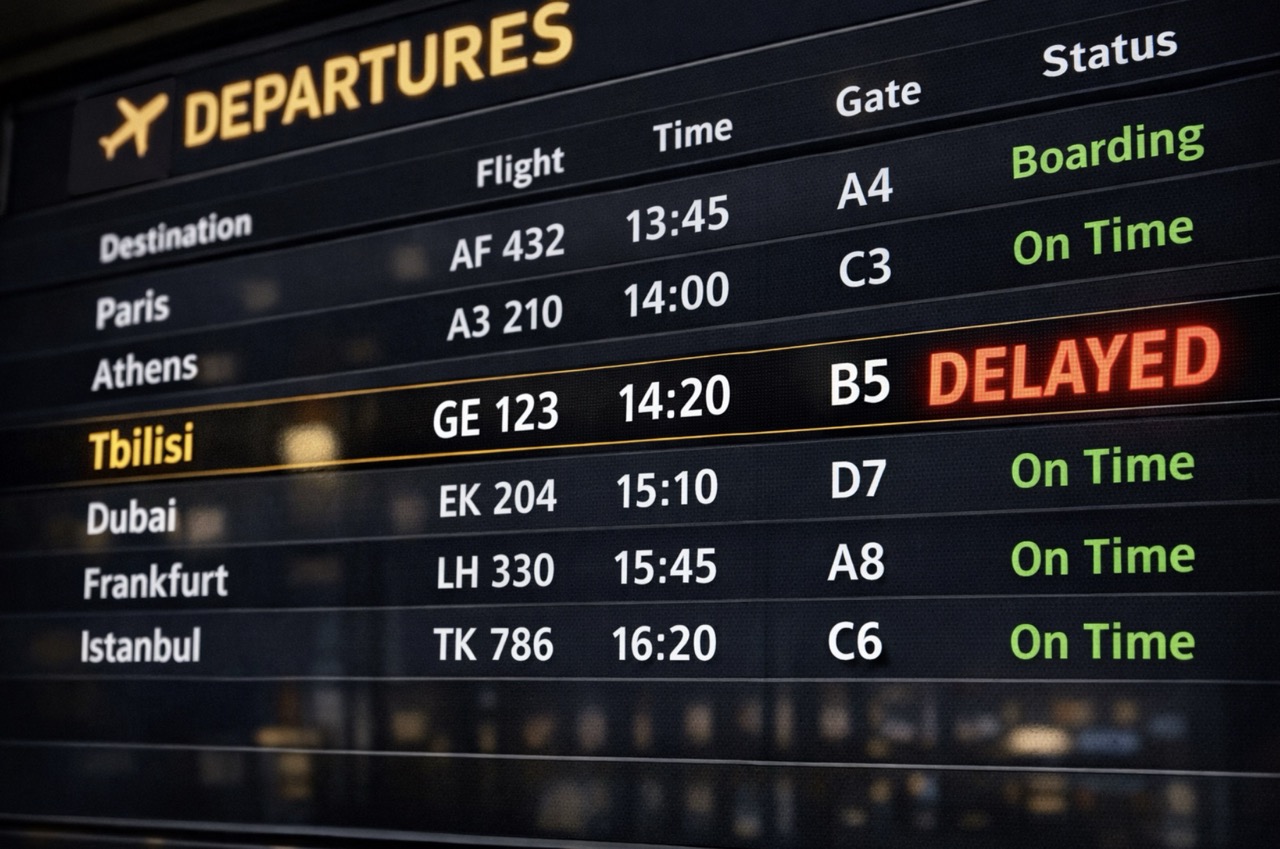
An unexpected flight delay is an unpleasant situation, especially if you have a scheduled time to pick up a rental car. However, knowing the proper procedure, you can correctly reschedule the car pick-up time so that it will be ready upon your arrival and your trip won’t be disrupted.

Notify us about the delay immediately

As soon as you learn about a significant flight delay, contact our company representatives right away. Do not postpone notification until your arrival — the sooner you inform us about the rescheduling, the higher the chances that the car pick-up can be adjusted without issues. We always accommodate clients in case of delays if we are informed on time. Prompt notification allows us to adjust the car delivery time or make changes to your booking according to the new arrival schedule.

How to properly notify about rescheduling the pick-up

Use a convenient communication channel for urgent contact. The easiest way is to call us directly or send a message via messenger (e.g., WhatsApp). You can also duplicate the information by email for certainty. In your message, be sure to include the key client and booking details:

  • Full Name (as in the booking)
  • Booking number (if provided upon confirmation)
  • Flight number and new estimated time of arrival (ETA)

For example: “Hello, this is Ivan Ivanov, booking №12345. My flight SU 186 is delayed, new estimated arrival in Tbilisi ~18:30 instead of 16:00. Please reschedule the car pick-up to the time of arrival.” Providing such information helps our staff quickly locate your booking and make changes. Please note that our company does not have a personal account system for independently modifying reservations — all communication is handled directly with managers, so it is important to notify us of any changes in advance.

What happens if you don’t notify

If you simply arrive late at the scheduled time without notification, serious problems may arise for both you and the company:

  • The car will not be ready on time. Our employee will arrive at the agreed time and may not find you. They may have to leave for other assignments, and the car pick-up will need to be rescheduled. As a result, you lose time, and the rental start will be delayed.
  • Risk of booking cancellation. Many rental companies cancel a reservation if the client does not show up at the scheduled time and does not make contact. In other words, the car may be given to another client. You would then have to urgently find another car, and the prepayment for the missed rental usually is not refunded.
  • Additional costs. Some companies charge a penalty for being late without notification. You may be billed extra for the car downtime or for staff working outside scheduled hours.
  • Limited choice of cars. If you arrive significantly late without notice, your chosen car may no longer be available (it could have been given to another client or removed from delivery). In this case, you will be offered a different model or will have to wait until a similar car becomes available.
  • Shortened rental period. The rental period will start from the originally scheduled pick-up time, even if you are late. Effectively, you lose part of the paid time if the rental schedule is not adjusted to your new arrival.

Obviously, no client wants to face these complications. It is much better to spend a few minutes making a call or sending a message than to deal with the consequences listed above.

Helpful tips in case of a flight delay

  • Track your flight status. Monitor departure and arrival information through the airline’s app or the airport’s online display. This way, you will immediately know about delays and can adjust plans in advance.
  • Keep contact details handy. Save the rental company’s phone, WhatsApp, and email in your phone before the trip. Upon arrival, if mobile service is unavailable, connect to airport Wi-Fi and send a message via messenger. It is important to have a way to contact us quickly, wherever you are.
  • Notify without delay. Inform us of the delay as soon as you receive confirmation of the flight change. Even if the delay seems minor (15–30 minutes), it is better to notify — this allows the rental staff to adjust the waiting time and prevents worry about your absence.
  • Check the company policy in advance. When booking, clarify or read the terms regarding how long the company will wait for you in case of a delay. Many keep the booking only for a limited period (e.g., one to two hours), after which the reservation may be canceled. Knowing this time frame helps you understand how critical it is to notify immediately.
  • Consider office hours. Pay attention to the rental company’s working hours. If the new estimated arrival time falls outside office hours, discuss in advance whether pick-up during off-hours is possible. Note that night delivery may incur extra charges or be postponed to the morning.
  • Get confirmation. Before departure and after sending the notification, make sure the company has received your message. If you sent an email or messenger message and received no response, try calling. The key is to get confirmation that the new pick-up plan is agreed upon.

Timely and proper communication with the rental company will help avoid unnecessary stress. Even in the event of a flight delay, your rental car will be delivered at the updated time and continue to wait for you — you just need to arrange it in advance. Our staff is always ready to assist if you keep them informed. Follow this procedure, and your car rental will start as smoothly as possible, despite the unforeseen flight issue.

How to Drive on Georgia’s Mountain Switchbacks: Tips for Tourists with an Automatic Car

Features of Mountain Switchbacks in Georgia

Georgia is a mountainous country, and winding switchback roads are common here. However, most popular routes have fairly good pavement and acceptable width. This means that major attractions are usually accessible via paved roads, where you don’t have to constantly reverse or “squeeze by” oncoming traffic, as is sometimes the case in other mountainous regions. Nevertheless, caution is advised: the mountainous terrain presents its own challenges—steep ascents and descents, narrow winding sections, and limited visibility around turns. Below we examine the most well-known mountainous routes and their characteristics:

Svaneti (Zugdidi – Mestia)

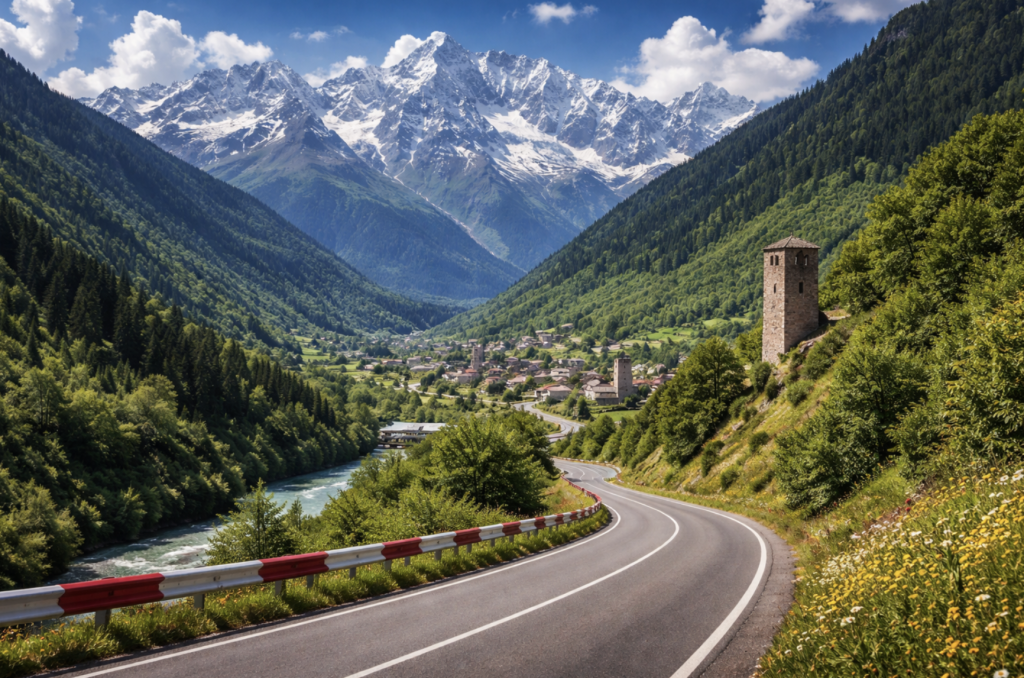
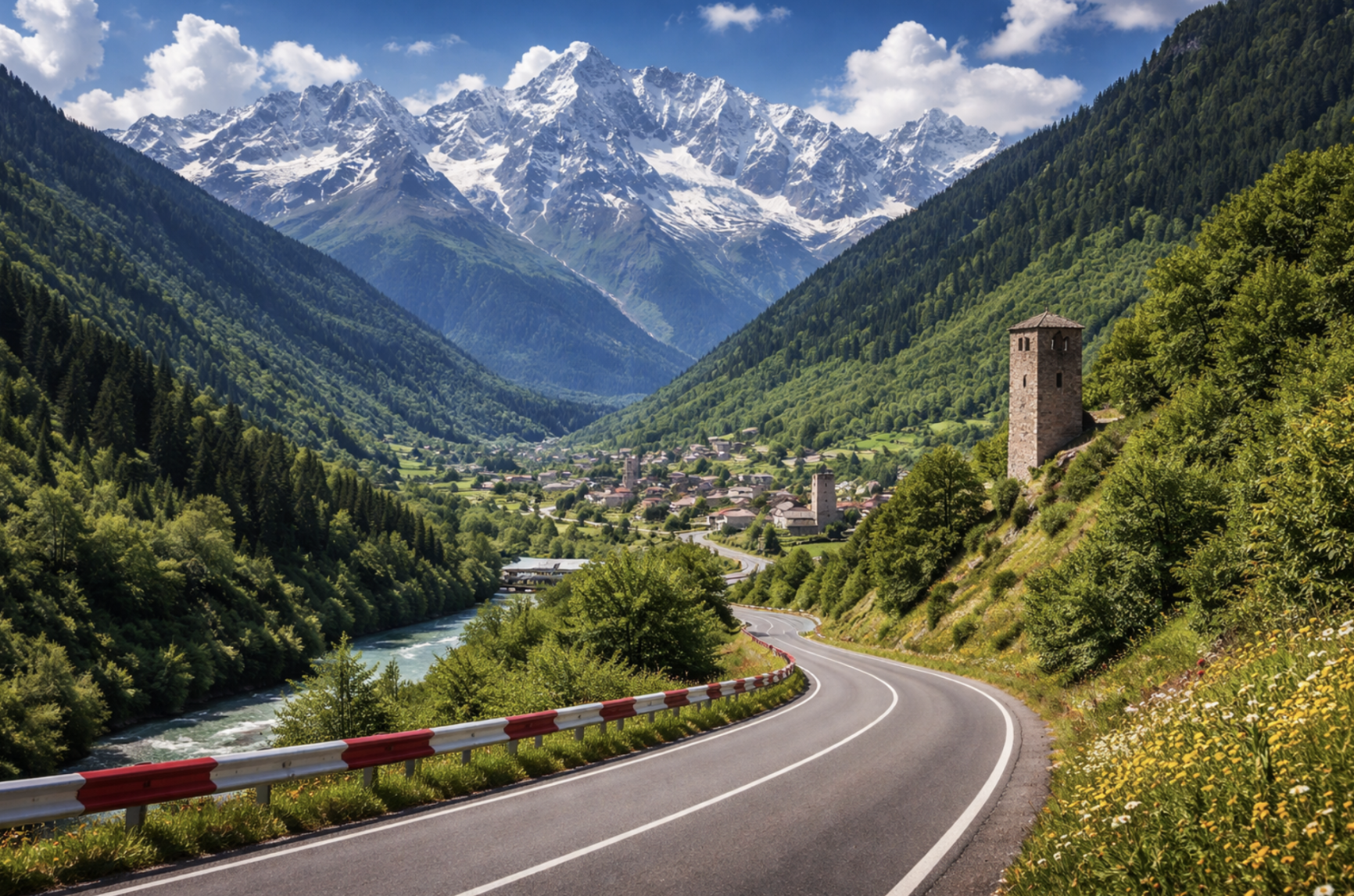
The road to Upper Svaneti is famous for both its beauty and difficulty. The stretch from Zugdidi to the village of Mestia (~130 km) is almost entirely a mountain switchback along the Inguri River. Covering this distance takes at least 4 hours, even though it looks short on the map. After the village of Jvari, the road begins steep curves and a continuous climb. The route has tunnels (about a dozen) and bridges, but also numerous sharp turns, ascents, and descents. In some sections, the road is narrow, with potential rockfalls and mudslides, especially in the off-season. This is a very picturesque route leading to highland villages with medieval towers, but drivers must remain extremely attentive. It’s no wonder the Zugdidi–Mestia road is considered one of the most beautiful and dangerous roads in the country.

Kazbegi (Military-Georgian Road)

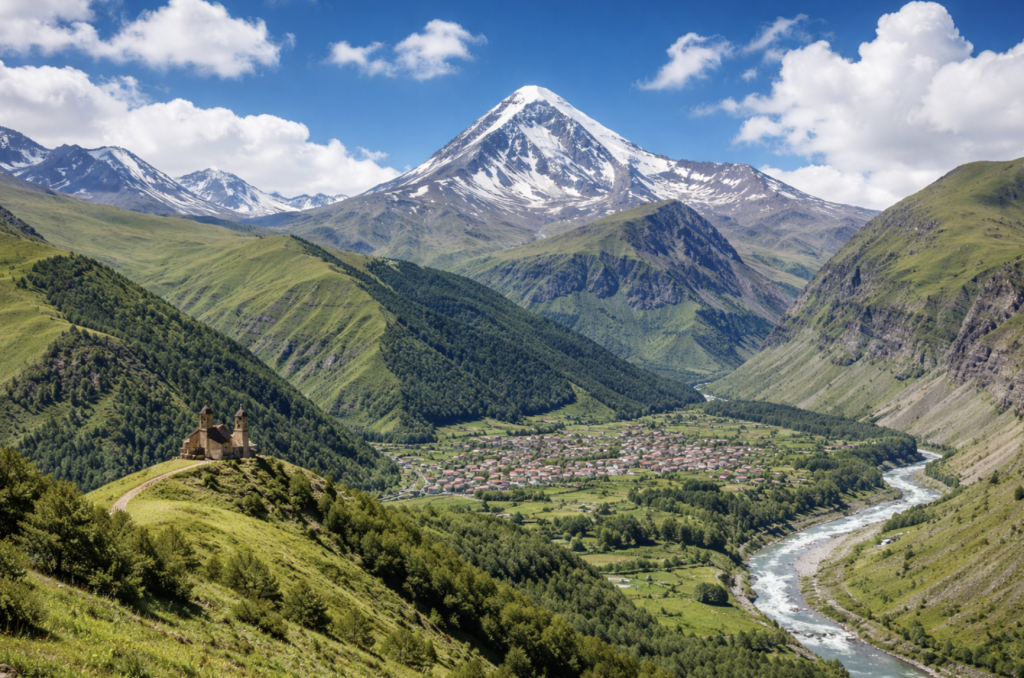
The route from Tbilisi through the Cross Pass to Mount Kazbek (town of Stepantsminda) is one of the most popular among tourists. The road passes through the Greater Caucasus Range, reaching an altitude of about 2,370 m at the pass. The Military-Georgian Road has an asphalt surface with one lane in each direction for most of its length. However, it is quite winding: in some places, the switchbacks are very sharp, with tight curves. Approaching the pass, there is a section called the “Mleta Descent”—a series of steep zigzags and loops. Extra caution is required in bad weather: fog, rain, or snow significantly complicate driving. Local drivers, familiar with the route, often drive quickly, making risky overtakes even on mountain turns. Tourists are advised to drive cautiously and follow the speed limit. Night driving on the pass is not recommended—you risk missing spectacular views and face greater stress due to limited visibility. If you are inexperienced in mountain driving, it is better to plan your pass during daylight. In winter, the pass may be temporarily closed due to snow or avalanche risk, so always check current conditions.

Western Georgia (Batumi – Kutaisi and Mountainous Adjara)

The main highway from Batumi to Kutaisi (via Zugdidi and Samtredia, part of the E60/E70 route) runs through lowlands and hills with a relatively gentle relief. This route is considered easy—it’s a standard two-lane road without extreme switchbacks. Pavement quality is good, and traffic can be busy, especially in summer. However, if you turn off the main highway into the Adjara mountains (for example, Batumi – Khulo – Akhaltsikhe via the Goderdzi Pass), you will encounter a challenging mountain switchback. The road there is narrow, with numerous hairpin turns, and in some places lacks reliable guardrails. The last 40 km to Batumi can take about an hour—the road becomes particularly winding near the final descent to the sea. Animals (cows, goats) often appear on these mountain roads, along with unexpected obstacles such as fallen rocks or streams crossing the road. Therefore, if taking alternative routes over mountain passes, be prepared for more extreme conditions. If you stay on the main roads between major cities, usually there are no special difficulties as long as you obey speed limits and stay attentive.

Despite the overall improvement of road conditions in Georgia in recent years, the driving style of locals may seem aggressive. Some drivers overtake on blind mountain curves and do not always follow rules, so foreign tourists must stay alert. Overall, driving on Georgian mountain roads is not frightening if you exercise caution. Many travelers report that with reasonable speed and careful driving, Georgia’s switchbacks are manageable even for drivers with average skills. The key is correctly assessing road conditions and your own capabilities.

Fundamentals of Safe Switchback Driving

The success of a trip on mountain switchbacks largely depends on following basic principles of safe driving. Below are key points to consider:

Speed and Driving Line

In the mountains, speeding is strictly prohibited—high speed on switchbacks can lead to loss of control. Always follow speed limits and reduce speed before every turn. Most mountain curves are blind, with zero visibility of oncoming lanes. Enter curves smoothly along the outside line and avoid “cutting” across lanes. Stay closer to the right edge of your lane, but do not drive onto the shoulder—it may be loose or nonexistent on mountain roads. Before a sharp bend, reduce speed enough to safely navigate without braking sharply within the curve. If you feel you are entering too fast, brake safely before the curve. Maintain a steady low speed through the curve, and only accelerate slightly after exiting. Always be prepared for potential hazards around bends: slow vehicles, animals, pedestrians, or fallen rocks.

Steering and Hand Position

On winding sections, hold the steering wheel with both hands at the “9 and 3 o’clock” position—this ensures maximum control. Make smooth steering movements without jerks. For very tight turns (almost 180° hairpins), you may need to reposition your hands—do so deliberately and in advance. Do not cross your hands excessively; work the wheel evenly. In emergencies (e.g., unexpected skidding), correct hand placement allows faster reaction and vehicle stabilization. Experienced drivers often wear thin gloves for better grip—hands may sweat in heat, and gloves prevent slipping. It’s not mandatory but useful for long mountain drives.

Following Distance

Keep an increased distance from the car ahead. In mountains, you cannot use the usual “city” distance—braking distances change unpredictably due to slopes and turns. If the vehicle in front brakes suddenly, you need enough space to stop safely. Increase distance also due to limited visibility: several cars may be ahead in a line, and a hazard (fallen rock, etc.) could appear two or three cars ahead—extra space gives time to react. Distance is especially important on descents: brakes heat up and lose efficiency, so extra space is your safeguard. On long ascents, do not follow closely behind slow vehicles; leave room for them to climb without pressure. If a car rolls backward while shifting on a slope (especially manual cars), distance prevents collision. Beginners in automatic cars should slow down and let the vehicle ahead complete the ascent before starting their own—safety is more important than saving a few minutes.

Overtaking on Mountain Roads

Overtaking on a switchback is the riskiest maneuver; avoid it if possible. On narrow one-lane roads, overtake only on well-visible straight sections where you are sure no oncoming vehicles are hundreds of meters ahead. If slow traffic (e.g., a truck) forms a line, wait for a legally allowed overtaking zone (marked by dashed lines and signs). Never overtake on a blind curve! Many locals risk overtaking on solid lines and blind bends—do not imitate this recklessness. Remember, rental cars do not have sports car dynamics, and you may be unfamiliar with road specifics. Better to lose a few minutes than risk a head-on collision. If a local driver aggressively tries to overtake, safely move to the right and let them pass; do not accelerate out of spite. Be aware that fast locals may flash lights, demanding right of way—remain calm, increase interval, and use the nearest turnout to let them pass safely.

Use of Horn

In mountains, it is considered appropriate to occasionally sound the horn before entering a blind sharp turn. This alerts oncoming drivers. Many Georgian drivers themselves honk on particularly tight curves—you can adopt this practice, especially when a warning sign “sound horn” appears. Do not overuse it, but signaling yourself in the mountains is useful. The horn can also scare off livestock (cows, horses) often found wandering on Georgian mountain roads.

Braking on Descents with Automatic Transmission

One of the main rules of mountain driving: use engine braking predominantly. This means downshifting on descents to let the engine slow the car rather than relying solely on the brake pedal. In a manual car, it is straightforward: shift to 2nd or even 1st gear at the start of the descent. But what about an automatic? Modern automatics also have modes suitable for mountains. Let’s examine engine braking techniques on an automatic and the available transmission modes:

  • D (Drive) mode – standard driving mode. On normal flat roads, the automatic shifts gears up for fuel efficiency. On steep descents, D may shift to a higher gear, causing the car to accelerate downhill and require constant braking. A common mistake for beginners is staying in D the entire descent and using the brake constantly, which overheats brake discs and pads, reducing braking efficiency and risking failure. On long descents in D, engage manual or lower gears.
  • L (Low), 2 or 3 mode. Many automatics have L (lowest gear) or numeric positions 1–3 limiting maximum gear. Use L or a lower gear on descents to prevent the transmission from upshifting and ensure consistent engine braking. On steep switchbacks, L keeps the car in 1st gear, controlling speed without brakes. In milder conditions, 2 allows shifting between 1st and 2nd gears. Some cars have S (Sport) mode—it keeps RPMs high and delays upshifts, useful on slopes.
  • M (Manual) or +/- mode. Many modern automatics allow manual shifting (paddle or gear lever). This is very convenient in mountains: you select gears yourself. Switch to manual mode on switchbacks and choose lower gears on descents. For example, before a steep descent, shift “-” to 2nd or 1st gear—the car moves slower, reducing brake load. On ascents, you can hold a gear to prevent unnecessary shifting. Manual mode gives better control on slopes.
  • Combined braking technique. Even with engine braking, you cannot entirely avoid the brakes. Correct approach: drive in lower gear and brake intermittently, avoiding prolonged pedal pressure. Never coast in neutral downhill—it’s dangerous and overheats brakes instantly. Keep a gear engaged; if speed rises, brake with short pulses, letting brakes cool. Continuous braking from top to bottom risks pedal fade and burnt smells—clear signs of brake overheating. Alternate engine braking and pedal to avoid this.

Why an automatic is convenient in mountains: for tourists unaccustomed to extreme driving, it reduces workload—no need for frequent shifting, allowing focus on steering and line. On long twisty ascents, automatics prevent stalling or rolling back—the torque converter ensures smooth hill starts. In busy resorts (e.g., Gudauri in summer), automatics are more comfortable—no fatigue from clutch use. Advantages: less stress for beginners, cannot select wrong gear, electronics prevent stalling mid-ascent.

Automatic limitations: must know how to use modes correctly. Driving “as on flat roads” without downshifting can overload brakes. Modern automatics (especially adaptive or Sport) often detect descents and hold gears, downshifting for assistance, but do not rely entirely—manual selection is safer. Also, transmission heat can rise during prolonged uphill driving in hot weather, but normally not critical if used properly.

In general, automatic transmissions are very convenient for tourists in mountains if used wisely. Many rental cars in Georgia are automatic, and thousands of travelers successfully navigate mountain routes following the rules above.

Seasonal Driving Features in the Mountains

Georgia’s mountain switchbacks require different skills depending on the season. Road conditions, weather, and traffic volume vary throughout the year. Below are the main seasonal factors:

Summer (June – August)

Summer is high tourist season. Traffic increases: minibuses, rental cars, off-road convoys. Narrow sections can be congested (roadworks or accidents). Plan early morning departures to avoid peak traffic, especially on popular routes like the Military-Georgian Road.

Temperature and vehicle load: daytime heat (up to +35 °C in lowlands; cooler but sunny in mountains) stresses engines and brakes. Long descents in heat increase brake overheating risk. Check brake response—if pedal feels soft or you smell burning, stop safely to cool down. High air temperature can also overheat engines on high-RPM climbs; check coolant and radiator before the trip. Cabin may be hot—ensure air conditioning or ventilation works, as opening windows on dusty mountain roads with wind is uncomfortable.

Mountain weather in summer: usually few rains, but thunderstorms occur. Heavy rain can wash roads with water and debris from slopes. Visibility drops, tires lose grip. In heavy rain, wait if possible; if driving, turn on low beams (or fog lights), keep even greater distance, and drive at minimal safe speed. Landslides are also possible in wet soil.

Tip: long summer days can make drivers complacent. Scenic views and relaxed passengers may distract. Do not look at landscapes while driving—one second can cause trouble. Stop at viewpoints to enjoy scenery. Always wear sunglasses—bright southern sun can blind you at critical moments on switchbacks.

Autumn (September – November)

Early autumn (Sept – early Oct) is favorable: cooler, fewer tourists, stable weather. Towards November, conditions become unpredictable: frequent rain, morning fog, first frosts in mountains.

Wet roads and leaves: fallen leaves are dangerous. After rain, wet leaves become slippery like ice. Tires lose grip, braking distance increases. Dry leaves hide potholes or wet spots. Reduce speed on leafy sections, avoid sharp maneuvers and braking.

Rain and mud: prolonged autumn rains can wash soil onto roads. Tires lose grip on wet asphalt—reduce speed below dry road limits. Rain with leaves worsens lane marking visibility. Use lights in fog or rain; stop if visibility drops below 50 m in a safe place.

Fog: Common in mountains in autumn. Entering a cloud may reduce visibility to a few meters. Use fog lights or low beams; never high beams. Drive in low gear, follow lane markings or roadside edge. GPS can help anticipate curves. Patience and minimal speed are essential. Fog is often local and clears after a few km or sunrise.

By late autumn (November), first snow may appear on high passes (Cross, Goderdzi, etc.). Night temperatures often drop below 0 °C. Be prepared for winter conditions—discussed below.

Car Rental in Georgia with Children: Rules, Child Seats, and Safety 2025–2026

Driving on Georgia’s mountain roads with children is an exciting adventure, but it requires special attention to child safety. Families planning a road trip in Georgia with a rental car should be aware of the current rules for transporting children. Here, we cover Georgia’s traffic regulations for child transportation (as of late 2025), child car seat requirements, fines for violations, and tips for tourists. We also compare Georgian rules with those in other countries (Russia, Belarus, EU, Israel, Asia) and list mandatory and recommended safety measures. Each section includes concise takeaways to help you quickly grasp key points.

Child Transportation Rules in Georgia: Law and Fines

Georgian law sets clear requirements for transporting minors. Key provisions of Georgia’s traffic rules for traveling with children:

  • Rear seat only: Children under 12 are not allowed to sit in the front seat of a passenger car. They must ride in the back – this is both a legal requirement and a basic safety measure.
  • Children under 3 years: Infants under 3 may ride either in a proper child car seat or on the lap of a seat-belted adult (16+) in the back seat. Important: one adult may hold only one child, and the adult must be buckled in. While the law allows lap travel, safety experts and international standards strongly discourage this – a car seat provides significantly better protection.
  • Prohibited unsafe transport methods: Children under 12 cannot ride on motorcycles, mopeds, or certain ATVs where a car seat cannot be installed. Standing passengers are prohibited – children must always be seated in proper seats.
  • Do not leave children alone: Georgian law explicitly forbids leaving children under 6 unattended in a parked car. Remember this rule during stops – in hot weather, cars heat up quickly, posing a severe risk.

Fines for violations: Non-compliance incurs a fine of 40 GEL (approx. $15). For example, placing a child under 12 in the front seat or failing to use a car seat or seat belt allows police to fine the driver. Although the fine is relatively small, these rules are designed to protect your child’s life and health.

Takeaway: In Georgia, children under 12 must ride in the back seat, and infants should use a car seat (lap travel allowed only up to 3 years, though unsafe). Violations carry a 40 GEL fine. Following the rules ensures the safety of young passengers.

Child Car Seat Requirements: Age, Weight, and Height

Even experienced parents often ask: which car seat is suitable for my child? Choosing and using the right child restraint system is a key safety factor. Georgian rules require car seats to match the child’s height and weight. Follow international classifications:

  • Group 0/0+ (newborns ~0–1.5 years): Weight up to ~10–13 kg. Use a carrycot or group 0+ seat installed rear-facing. Infants ride semi-reclined or lying down, secured with internal harnesses. Seats usually have a carry handle; disable the front airbag if installed on the front seat (though in Georgia, infants must ride in the back).
  • Group 1 (toddlers ~1–4 years): Weight ~9–18 kg. Seat installed forward-facing, secured with seat belt or ISOFIX. Child buckled with internal harness.
  • Group 2 (preschoolers ~4–7 years): Weight ~15–25 kg. Usually a high-back booster or convertible seat. Child uses car’s seat belt, elevated by booster. Backrest adds support and protection.
  • Group 3 (young schoolchildren ~6–12 years): Weight ~22–36 kg (up to ~12 years). Booster (sometimes without backrest) for children not tall enough for proper seat belt positioning. Seat belt must cross shoulder, not neck – booster ensures correct alignment. EU standards require child restraints until ~135–150 cm tall. After that, normal seat belt may be used without booster.

Beyond weight groups (ECE R44/04), modern i-Size (ECE R129) seats classify by height. For example, i-Size seats allow rear-facing travel up to 105 cm (~4 years). The main point: the seat must fit the child. Too large reduces restraint effectiveness; too small is uncomfortable and unsafe. Always check the seat’s weight/height range and install correctly.

Takeaway: Use a car seat matching your child’s age, weight, and height. Newborns ride rear-facing, preschoolers in seats or boosters, all properly harnessed. Seats should be certified (ECE R44/04 or R129) and correctly installed – a properly chosen seat is the foundation of a safe journey.

Tourist Considerations: Car Rentals and Child Seats

Do I need to bring my own car seat? Can I go without one? These questions often concern tourists renting cars in Georgia. Key points:

  • Georgian rules apply to everyone: Local or foreign, traffic laws are mandatory. Children must ride according to the same rules. Lap travel for under 3 years exists but is not recommended. In most other countries, this practice is considered unsafe, so it’s better to have a proper seat.
  • Rental car seats: Most Georgian rental companies offer child seats. Our company provides seats free on request – specify the age/size of your child when booking. Seats cover different age groups (0+/1 for infants, 2/3 boosters for older children). Availability may be limited during peak season, so book in advance.
  • If traveling in your own car: Ensure your seat meets requirements. European tourists can continue using familiar boosters – fully compliant with Georgian rules. Buckle both children and adults. Optional: “Baby on board” sticker – not required in Georgia but may alert other drivers.
  • Taxis and transfers: Taxi vehicles usually lack child seats. Georgian law does not mandate them. Bring a portable booster or request a service with a seat. If unavailable, buckle your child with you and exercise extra caution.

Takeaway: Tourists should arrange a car seat in advance. We provide seats free on request. Avoid lap travel even if technically allowed for children under 3 – the risk is too high. Proper safety ensures a worry-free trip.

Rules in Other Countries: Comparison with Georgia

Understanding differences in child transport rules helps international travelers. Georgian rules are somewhat lenient (allowing lap travel under 3). Here’s a comparison with other countries:

  • Russia: Strict, similar to EU. Children under 12 must use restraint systems. Under 7 – car seat or booster mandatory in rear; 7–11 – rear seat with seat belt allowed, front seat requires car seat until 12. Fines: ~3,000 RUB (~$35). Georgian rules are softer, but higher safety standards are recommended.
  • Belarus: Similar to Russia. Under 12 or below 150 cm – car seat/booster required. Front seat only with car seat; rear-facing front seat prohibited if airbag active. Lap travel strictly forbidden. Fines: up to 98 BYN (~$30).
  • European Union: Children under 12 or ~135 cm must use car seat/booster. In some countries (Germany, Italy, France), requirement up to 150 cm (~11–12 years). Lap travel prohibited; rear-facing mandatory for infants. Fines significant (Italy €80–€323).
  • Israel: Similar to EU, lower threshold: under 8 or 145 cm must use seat/booster. Infants under 1 year – rear-facing only; fines: 250 ILS + 6 points. Not using a seat for under 8 fines ~750 ILS (~$200). Front seat allowed only with car seat; back seats preferred.
  • Asia: Rules vary. Developed East Asian countries (Japan, South Korea, Singapore) follow EU-like standards: e.g., Japan – children under 6 or below 140 cm must use seat/booster. Developing regions may have lax rules; e.g., Thailand enacted law in 2022 for under 6. China gradually enforcing standards. Georgian rules (2025) align more with global norms, except the lap-travel exception under 3.

Takeaway: Compared to Russia, Belarus, EU, and Israel, Georgia’s rules are slightly more lenient (lap travel under 3, no booster mandatory after 3). Global trend: children under 12/~135 cm must use car seats or boosters; lap travel prohibited. For trips, follow the strictest rules for maximum safety.

Mandatory and Recommended Safety Measures

Having a car seat is not enough – other measures are crucial for child safety. Below are mandatory requirements and additional recommendations for traveling with children:

  • Buckle all passengers: Everyone must be buckled. Ensure belts are correctly positioned (shoulder/chest, lap over hips). Never hold a child on a buckled adult – each must have their own restraint.
  • Proper seat installation: Install per manufacturer instructions – with seat belt or ISOFIX/LATCH. Seat should not move more than a few centimeters. Backrest angle ~45° for newborns; boosters must guide the car’s belt correctly.
  • Lock doors and windows: Use child locks on rear doors. Lock windows as needed.
  • No children on laps or outside seat while moving: Even if fussy, children must remain restrained. Stop to adjust or calm them. Lap travel prohibited except under 3 years (adult buckled).
  • Remove loose items from the cabin: Store heavy items in the trunk; small objects in compartments. Soft toys preferred.
  • Control cabin climate: Maintain comfortable temperature. Never leave children alone in a car. Remove thick jackets before belting; cover with blanket if needed.
  • Lead by example: Follow traffic rules. Children model adult behavior – emphasize safety.

Takeaway: Maximum safety comes from: proper seat selection/installation, buckling everyone, locking doors, securing items, controlling climate. These steps significantly reduce road risks.

Tips for Driving with Children in Georgia

Georgia’s roads are scenic but challenging. Mountain terrain, switchbacks, and changing weather demand careful driving. Here are tips for comfort and safety when driving with children:

  • Plan your route and timing: Mountain roads (e.g., Kazbegi via Georgian Military Highway, Svaneti switchbacks, Batumi–Kutaisi passes) may take longer than GPS shows. Schedule stops every ~1.5–2 hours for children to stretch and for driver rest.
  • Avoid night driving: Avoid unfamiliar mountain roads at night. Visibility is lower; risks higher. Easier to assist children during the day.
  • Prevent motion sickness: Avoid heavy meals before travel. Offer water in small sips. Consider pediatric remedies if needed. Drive smoothly on switchbacks; stop if the child feels nauseous. Distraction (songs, stories) may help.
  • Mountain driving style: Use lower gear on descents, avoid overheating brakes. Enter turns slowly, signal intentions. Reduce speed on poor surfaces. In rain/fog, exercise extra caution. Minimize sudden maneuvers for children’s comfort.
  • Account for temperature changes: Prepare for altitude and coastal heat differences. Carry warm clothes and sun protection. In winter, ensure proper tires/chains. Maintain comfortable cabin temperature and monitor children.
  • Entertainment and comfort: Bring toys, books, or download cartoons (with power bank). Keep wipes, trash bags, water, and snacks handy. Calm children = calmer driver.

Takeaway: For trips in Georgia with children, planning and caution are key. Travel slowly, make stops, prevent motion sickness, ensure comfort. This ensures an enjoyable experience for all.

Driving in Georgia with children is a wonderful experience if approached responsibly. Follow local child transport rules, adhere to global safety best practices, ensure an appropriate car seat (we provide one free for convenience), plan routes considering children’s needs, drive attentively, and be patient. This way, Georgia’s mountains, coasts, and cities will reveal their most welcoming side, while your family remains safe every kilometer. Enjoy your trip and safe travels!

SIM Cards in Georgia: Complete Guide for Tourists and Business Travelers (2025–2026)

Overview of Georgia’s Mobile Market

The mobile market in Georgia is represented by three main operators: Magticom, Silknet (formerly known as Geocell), and Cellfie Mobile (the new name for Beeline). They operate on GSM/3G/4G standards, and since 2023–2024, they have also deployed 5G (NSA) networks on dedicated frequencies. Magticom is considered the market leader in terms of subscribers and network quality. Its network covers about 90% of the country’s territory, providing the most stable coverage even in mountainous and remote areas. According to Ookla research, MagtiCom’s mobile internet was among the six fastest in the world in 2025. Silknet holds the second position in market share and is actively expanding its infrastructure; coverage is around 80% of Georgia, with particularly good service in cities and popular tourist areas. Cellfie (formerly Beeline) is the third operator, attractive due to its affordable tariffs. Its coverage is currently about 50% of the country (mainly in major cities and resorts), but the network is expanding, and the operator is already implementing 5G in certain regions. Overall, all three companies offer modern services, high-speed mobile internet, and compete for subscribers, which benefits consumers in terms of pricing.

Network Quality and Coverage. All operators provide reliable 4G/LTE coverage in most populated areas. MagtiCom historically has the widest network of base stations: according to its own data, its LTE covers over 90% of Georgia’s population, including good connectivity even in Tbilisi metro tunnels. Silknet also offers 4G across most of the country (up to ~90% of the population according to some estimates). Being a smaller operator, Cellfie nevertheless covers major cities and resorts, though signal may drop in remote areas. With the introduction of 5G, internet quality has further improved: Magticom has launched nationwide 5G (700 MHz, 2600 MHz, 3500 MHz), Silknet currently provides 5G locally (in central Tbilisi at 2100 MHz), and Cellfie has deployed 5G in major cities and tourist zones. For users, this means that with a modern smartphone, you can expect fast mobile internet (especially in Tbilisi, Batumi, and other major centers). Nevertheless, travelers across the country often note that Magticom provides the most stable reception and speed on highways and in the mountains. Silknet is only slightly behind in quality, particularly along popular routes, while Cellfie’s network may be weaker outside cities. In terms of reliability, the typical operator ranking is: Magticom first, Silknet second, Cellfie third. However, your choice also depends on your needs and budget, which we will discuss further.

Main Operators’ Tariffs and Services: Comparison

Georgia’s operators offer a wide range of tariffs, especially prepaid packages, aimed at both residents and visitors. Overall, service costs are relatively low compared to European countries: for example, 1 GB of data may cost about 5–7 GEL, and unlimited offers are often available. Almost all package plans include unlimited local calls and SMS within Georgia (at least within the same network, often to all networks) – a noticeable advantage for travelers. Below is a comparison table of tourist prepaid packages from Magticom, Silknet, and Cellfie, popular at the end of 2025:

OperatorData PackageLocal Calls/SMSInternational CallsValidityCost
Magticom3 GB mobile internetUnlimited (all Georgian networks)**30 min (to other countries)*15 days30 GEL
SilknetUnlimited internetUnlimited (all Georgian networks)30 min (international)*15 days30 GEL
Cellfie2 GB mobile internetUnlimited (all Georgian networks)50 min (to other countries)*15 days20 GEL

Note: international minutes can be used with the prefix “00” or “+” before the country code. Unlimited local calls apply to Magti, Silknet, Cellfie, and landline numbers within Georgia.

As seen, Cellfie offers the most budget-friendly tourist package – 2 GB and calls for 20₾, which can be suitable for a short trip. Silknet is attractive because for 30₾ it provides unlimited mobile internet for 15 days, plus unlimited local calls and SMS. Magticom at the same price of 30₾ offers 3 GB and a bonus of 30 international minutes, convenient for contacting people abroad. All three packages are valid for 15 days, making them ideal for tourists or short business visits.

Regular prepaid tariffs. In addition to tourist offers, operators provide standard prepaid packages of various sizes for a month. For example, Magticom offers 5 GB of internet for 30 days for ~12 GEL, and unlimited internet for a month costs around 32 GEL. Silknet has a similar range – packages from a few gigabytes to large volumes; 20 GB per month costs about 60–65 GEL (prices in official stores; airport tariffs may be higher, see the table above – 20 GB was offered for 65 GEL). Silknet’s advantage is all packages include unlimited calls and SMS within Georgia. Cellfie is known for the lowest data prices: 5 GB for 30 days costs ~7 GEL, 16 GB – ~15 GEL, and 40 GB – ~20 GEL. This makes Cellfie a great choice for those who need large amounts of internet for minimal cost, if coverage in your location is sufficient. All operators also allow purchasing additional minutes or SMS, though with widespread use of messaging apps, SMS is less frequently used.

Special services. Each operator offers additional services: for instance, MagtiCom has the “All Without Limit” line (packages with unlimited calls, SMS, and a certain amount of internet), Silknet has tourist packages as described above, and also the ability to add discount options for international calls. International calls beyond included minutes are charged at standard rates, but there are tips: MagtiCom provides code 1010 to reduce international call costs (via VoIP gateway), and Silknet offers special discounts to popular destinations. Many travelers use internet calls (WhatsApp, Skype, etc.) to save money, leveraging large data packages. Roaming is also possible on Georgian SIMs: roaming rates are usually high, so operators offer special roaming packages. For example, Silknet offers 1 GB for 7 days in Europe and Turkey for 9 GEL – very competitive for roaming. Magti and Cellfie have similar packages for popular destinations. Overall, if you plan trips across the region, it’s often better to buy local SIMs in each country or use eSIM solutions (more on that later).

Overall, Georgian operator tariffs are flexible and affordable. Next, we will discuss practical aspects of purchasing and using SIM cards in Georgia, and choosing between prepaid and postpaid options.

SIM Card Purchase: Registration and Documents

In Georgia, SIM card registration is mandatory using a passport or another identity document. You will need to present your passport when buying a SIM card (residents can use an ID card). Registration usually takes only a few minutes: the seller scans or records your passport details in the system and registers the SIM in your name. This procedure is required by law and is the same for all operators. Note that without an ID, you cannot purchase a SIM – so plan to have your passport ready upon arrival if you want to buy a card at the airport.

Cost and activation. The SIM itself in official stores may have a small price (e.g., 5–10 GEL) or be free with the purchase of a starter package. At Tbilisi and Kutaisi airports, tourists usually receive the SIM for free if they immediately pay for a package (see MagtiCom offers above – the “Free 4.5G SIM-card” is included in the tourist package). In city offices, the standard SIM price may be about 10 GEL (Magticom), though this often includes initial balance or starter minutes/data. After registration, the SIM is usually active immediately, or the seller helps activate the starter package (sometimes requiring a USSD command listed on the package or making the first call). For example, to activate a new Silknet SIM, you dial *7010# or *100# according to instructions. Check upon purchase that the SIM is activated and the desired tariff is applied – airport counters do this automatically; in stores, you may need to activate it yourself (instructions usually included).

Language considerations. Not all store staff speak Russian or English fluently, especially outside tourist areas. In Tbilisi and major cities, communication is usually possible, but it is useful to have the operator name and tariff written down, or ask to activate a standard tourist package. After activation, many SIMs send SMS and voice menus in Georgian by default. However, you can change the language: for Silknet, you can select English/Russian via *180#, other operators have similar USSD codes (check when purchasing). Overall, buying a SIM in Georgia is tourist-friendly: simple registration, passport accepted without bureaucracy, no registration fees.

eSIM: Electronic SIM in Georgia

By the end of 2025, all major Georgian operators support eSIM (embedded SIM) technology. This means you can avoid a physical SIM, downloading the operator profile to your smartphone via QR code. eSIM simplifies connectivity: it can be purchased online from anywhere and activated upon arrival without visiting an office.

Magticom: offers eSIM alongside regular SIM cards – costing about 10 GEL, available in stores and online. MagtiCom’s website has an Online Order option to buy eSIM, but it’s easier for foreigners to visit an office to receive a QR code for download. Silknet: also supports eSIM, with connection costs from ~4 GEL for a standard number. Silknet sometimes provides bonuses for eSIM: 2000 MB and 50 minutes. eSIM can be obtained via Silknet’s website (requires registration and a Georgian number) or in official stores. Cellfie: eSIM can be purchased fully online – on cellfie.ge, you upload passport photo and selfie for ID verification. Cost ~5 GEL, QR code issued after verification. Note that this process may take some time (not instant like a physical SIM in a kiosk). It is recommended to buy eSIM online from your phone to scan the QR code immediately.

eSIM benefits for travelers are obvious: you save time at the airport and can connect immediately upon arrival – just install the eSIM profile beforehand (e.g., from home) and it activates automatically in Georgia. Your main number (physical SIM) can remain in the phone, so the device works with two lines simultaneously. Important: ensure your device supports eSIM and is unlocked for foreign operators. eSIM is excellent for short trips or frequent travelers who need to switch operator profiles quickly. All packages and tariffs available on physical SIMs are also available on eSIM. For example, Silknet allows selecting any plan when activating eSIM. Thus, having eSIM from Georgian operators adds flexibility: you can get local service without visiting a store or quickly switch operators for backup coverage.

Where to Buy a SIM: Airport, City, Online

Airports. The easiest way for tourists to get a SIM is upon arrival – Georgia’s international airports have counters/kiosks of mobile operators. In Tbilisi airport arrival area, all three operators are represented: Magticom and Cellfie have counters in the hall, Silknet (Geocell) slightly off to the exit. Kutaisi and Batumi airports usually have major operators or partner sales points. Buying at the airport is convenient – you get a ready tourist package, often SIM is free, paying only for the package (e.g., MagtiCom: 15 or 30 GEL for package, SIM $0). Downsides include limited tariff choice and slightly higher prices for small packages. For example, Silknet airport prices: 1 GB – 25 GEL, 5 GB – 35 GEL, etc., higher than city prices. Experienced travelers sometimes recommend not buying at the airport, but going to the city for more options and possible savings. However, if you need immediate connectivity (ordering taxi, contacting hotel), paying extra at the airport is worth the convenience.

 Example of a promotional poster for Cellfie’s tourist package at Tbilisi airport arrivals. It shows 2 GB of internet, unlimited local calls/SMS, and 50 international minutes for 20 GEL, valid for 15 days. Counters operate round-the-clock to allow arriving visitors to get local SIMs immediately.

Official stores. In cities, you can buy a SIM at official Magticom, Silknet, or Cellfie stores, or from authorized dealers (e.g., in malls, electronics stores). In Tbilisi, there are many stores for all three operators – addresses available on websites (tourists usually visit central stores). In Batumi, Kutaisi, and small tourist towns (Borjomi, Telavi, etc.), at least a Magti or Silknet store is usually present. Buying in a store offers advantages: wide tariff choice, consultants help pick the best package, promotions often available (bonus GB for larger packages). Payment options: cash or card. Downsides: store hours (usually 10:00–19:00, weekends until noon), queues. Overall, registration is quick. In stores, you can top up your balance immediately and enable auto-renewal if staying longer.

Online purchase. As mentioned in the eSIM section, some operators allow ordering SIMs online. MagtiCom has an online store to reserve a SIM or select a preferred number, but collection still requires visiting an office or delivery to a local address. Cellfie offers a full online cycle for eSIM. International services also sell pre-registered Georgian SIMs by mail, though less common given visa-free entry for most. Another option is international tourist SIMs and eSIMs. If you want to save time or avoid language issues, you can buy a universal travel SIM (e.g., TourSIM by EuroRoaming or eSIM from Airalo). They work in Georgia via local operators (usually Silknet or Cellfie), but tariffs are usually higher. For example, 5 GB for 15 days via international eSIM costs ~$15–20, whereas local SIM gives 5 GB for ~$5–7. For longer stays, it’s more economical to buy a local Georgian SIM.

Conclusion: for tourists, the ideal scheme is to get a SIM upon arrival (if immediate connectivity is needed) or in a nearby city store (for savings and maximum tariff choice). The key is not to forget your passport and decide on the operator (see previous sections on coverage and prices).

Prepaid or Postpaid: What to Choose?

Georgian operators provide both prepaid (top-up cards) and postpaid (contract with monthly billing) options. For foreign visitors, prepaid is almost always optimal. Key differences and recommendations:

  • Prepaid SIM: sold to anyone without long formalities – pay and use. You top up the balance and activate desired packages. No monthly obligations: if you don’t pay, SIM simply waits. Convenient for tourists and business travelers: you control spending and can buy SIM just for the trip. All packages described above (tourist, internet) are prepaid. Pros: easy to obtain (passport needed only for registration), full expense control, no penalties for non-use. Cons: slightly higher per-minute/MB cost outside packages than contracts; balance validity limited (usually SIM deactivates after ~6 months without top-up). Not relevant for a standard trip.
  • Postpaid (Contract): monthly billing plan, usually requires signing a contract at an operator store. Contracts benefit permanent residents: often more packages for less cost (e.g., unlimited internet, large minute packages, device discounts). However, contracts may be unavailable to foreigners without residency. Operators typically require local ID or proof of long-term stay, sometimes a deposit. Pros: better conditions for long-term use, ability to link a bank card and not worry about balance, sometimes premium services (network priority, service subscriptions). Cons: longer setup, may require Georgian tax ID or deposit, minimum contract period (e.g., cannot disconnect after 1 month without penalty). Not convenient for short visits.

Recommendation: if you are a tourist or on a short business trip, choose a prepaid SIM. You get all necessary services without bureaucracy. Prepaid packages in Georgia are generous and inexpensive; postpaid benefits for short stays are minimal. Postpaid makes sense only for long-term residents or if you want multiple SIMs in a family plan or a top unlimited plan and are ready to sign a contract. Otherwise, “pay in advance” is simpler. Note: network quality and priority are usually the same for prepaid and postpaid – operators do not limit prepaid users’ speed (5G/4G users get full bandwidth).

Mobile Connectivity for Business Trips

If you are visiting Georgia for work or as a digital nomad, connectivity is crucial for productivity. Fortunately, Georgia’s mobile infrastructure is sufficiently developed to ensure comfortable business travel. Key points to note:

  • Internet speed and 5G: As mentioned, 5G is already available in major cities. In Tbilisi, Batumi, Kutaisi, mobile internet can exceed 300 Mbps on MagtiCom. Video conferences, large file transfers, cloud services – all work smoothly. Even on 4G, Magti and Silknet average 20–50 Mbps, sufficient for work tasks. If internet is critical, Magticom is recommended – consistently fastest and most reliable. Silknet provides good speed and low latency. Cellfie is slightly slower and more latent but sufficient for basic office tasks. Coverage matters: Magti provides internet even in areas where others may not reach.
  • Reliability and coverage in business areas: In Tbilisi business centers (Vake, Saburtalo, Mtatsminda), all operators have dense cell networks. Modern office buildings often have signal repeaters. In hotels and business centers in Batumi and other cities, similar situation. For trips to wineries in Kakheti or mountain resorts like Gudauri, check coverage: Magticom is preferred, historically best “in the field” connectivity. Silknet is also good in tourist spots. Tip: If work requires constant connection, consider two SIMs from different operators – e.g., Magti and Silknet – to switch if needed. Low tariffs make this affordable and provides backup for rare local outages.
  • International calls and conferences: Business travelers may need foreign contact. Standard Georgian prepaid tariffs include some international minutes (tourist packages: 30–50 min), but regular international calls may require an extra service. MagtiCom offers code 1010 for cheaper calls, Silknet offers special packages to CIS, Europe, etc. Most use Zoom/Skype/Teams; mobile internet supports this. 4G/5G networks in Georgia suffice for video conferences; major cities also have Wi-Fi in cafes/hotels – for security, prefer your own 4G router. Roaming is costly, but regional packages exist: Silknet 1 GB in Turkey for 9 GEL, MagtiCom and Cellfie offer similar. Often better to buy a local SIM in the destination country.
  • Additional features: Operators offer business-useful services. Hotspot/tethering allowed at no extra cost. MagtiCom has Mono Credit – mini credit for urgent calls if your balance runs out. All operators have mobile apps (MyMagti, Silknet, Cellfie) with English interface: monitor expenses, activate options, pay by card. Note: foreign cards may not always work; have cash or local card, or use intermediaries. For longer stays, corporate solutions exist (private groups, company tariffs), beyond this overview.

Summary for business trips: choose a reliable operator (Magticom or Silknet), connect sufficient data (20–30 GB or unlimited for a month), consider eSIM to keep your main number, and use operator apps for control. Then connectivity in Georgia will be an asset, not a problem.

Mobile Connectivity for Tourists: Convenience While Traveling

Tourists in Georgia are generally very satisfied with local SIM cards: inexpensive, hassle-free, and always connected. Here are key features and tips for travelers:

  • Special tourist packages. As shown in the table, all operators have 1–2 week packages – ideal for typical vacations. Turist Start from Silknet for 15 GEL gives 4 GB, local and some international minutes for 15 days. Magti Tourist for 30 GEL – 3 GB and 30 min abroad. Cellfie Tourist for 20 GEL – 2 GB and 50 min abroad. There are also short-term options: Silknet offers 7-day package – unlimited internet and SMS for 15 GEL. Packages usually come preloaded on the SIM; insert and ready. Package renewal: some tourist tariffs auto-renew if balance remains. To prevent this, disable auto-renew via USSD (e.g., Silknet). If staying longer, letting it auto-renew is convenient.
  • SIM lifespan and inactivity. Prepaid SIMs bought by tourists usually remain active for a certain period after the last usage. For MagtiCom, the SIM is active for up to 12 months from the last top-up or use; for Silknet and Cellfie, it is typically 3–6 months. Exact numbers are not always publicly advertised, but the rule is simple: using the SIM at least once within this period prevents deactivation. For short trips, this is not an issue. If you plan to keep the number for a longer stay or return visits, you can top up online to extend validity. All operators allow topping up via websites, apps, or card payments, so your number can remain active even without physical presence.
  • Convenience during travel. Once you have a local SIM, navigating Georgia becomes easier: mobile maps (Google Maps, Maps.me) work smoothly, ride-hailing apps (Bolt, Yandex.Taxi) are fully functional, and translation apps or online guides remain accessible. Even in mountains, MagtiCom and Silknet provide coverage along main routes and popular hiking areas. Cellfie works best in cities and well-known tourist spots. Tip: if traveling off the beaten path, consider having two SIMs (Magticom + Silknet) or using eSIM as backup for coverage gaps.
  • Costs and efficiency. Prepaid SIMs are extremely affordable. For example, a typical tourist 15-day plan costs 20–30 GEL (~$8–12 USD) and includes several GB of internet plus unlimited local calls/SMS. Compared to using roaming from your home country, this is significantly cheaper. Packages can be renewed or expanded easily: add 1–5 GB extra, purchase extra minutes, or switch to unlimited internet if needed. Operators also provide online monitoring of usage, so you can control data and avoid overspending.
  • Language and support. Operator apps and websites are mostly available in English and Georgian; some staff speak Russian. Prepaid SIMs come with simple activation instructions via USSD or app. Customer support is available via hotlines or chat for troubleshooting, making it easy to solve any connectivity issue during your stay.
  • Summary for tourists: Buying a prepaid SIM in Georgia is simple, inexpensive, and convenient. Use MagtiCom for the widest coverage, Silknet for competitive unlimited packages, and Cellfie for the most budget-friendly options in cities. Consider eSIM for immediate activation and backup, especially for short trips. Keep in mind your SIM’s validity period, top up when necessary, and you will enjoy uninterrupted connectivity throughout Georgia.

Car Rental in Georgia for New Year: Features, Vehicle Selection, and Tips

New Year is a special time when having personal transportation becomes almost a necessity. During the pre-holiday rush, there is a lot to get done: buying gifts, visiting relatives, and preparing everything for the festive table. Renting a car for the holidays helps handle all these tasks without unnecessary hassle. In winter, traveling by car is especially pleasant — you are not dependent on public transport schedules or the whims of the weather. Moreover, modern rental cars are usually equipped with everything needed for safe winter driving (winter tires, interior heating, etc.), making trips comfortable even in cold weather.

Features of car rental during the New Year holidays

During the New Year holidays, demand for car rentals traditionally increases, so it is recommended to book a vehicle in advance. Many car rental services note peaks in customer activity on New Year’s Day and the following Christmas period. Due to high demand, the selection of available models decreases, and prices for popular categories may temporarily rise. For example, renting an all-wheel-drive SUV in January (to get to a ski resort) will cost more than the same model at the end of March. When planning your trip, try to reserve a car several weeks before the holidays — this way you are guaranteed to get a suitable vehicle at the best price.

Please note that in winter all vehicles in Georgia must be equipped with seasonal tires — this requirement is in effect from December 15 to March 1. A responsible car rental company prepares its fleet for winter in advance, so rental vehicles usually already have winter tires and the necessary equipment. If you are planning to travel to the mountains, it is also worth checking road conditions. Mountain highways in Georgia are generally passable for most vehicles in winter, but during heavy snowfall certain sections (for example, the road to Gudauri) may be temporarily closed. Always check current conditions and the weather forecast before traveling to remote regions. Otherwise, car rental in Georgia for New Year is no different from standard rental: you receive a fully fueled, well-maintained vehicle with the necessary insurance and support so you can enjoy your trips without obstacles.

Best vehicles for winter trips

When planning a car rental for the New Year holidays, it is important to choose the right type of vehicle. Focus on your needs and route:

  • For city driving and travel between major towns, compact economy models or comfortable sedans are suitable. Such cars are cheaper to rent and consume less fuel — an optimal choice if you plan to stay on paved roads and want to save money.
  • For mountain routes and winter roads, it is better to rent a crossover or an all-wheel-drive SUV. Vehicles with higher off-road capability provide greater ground clearance and stability on snow and ice. SUVs or AWD crossovers are ideal for mountain trips — they offer better traction on slippery roads and greater safety in challenging conditions.
  • If you are traveling with a large group (family or friends) and carrying a lot of luggage or gifts, consider spacious minivans or 7-seat SUVs. A roomy interior and large trunk allow all passengers to travel comfortably and take everything they need. Such a vehicle is especially relevant for long-distance trips, where comfort and space are a priority.

Regardless of the vehicle class you choose, make sure the car is technically sound and prepared for winter. At CabrioGE, a car rental company, all essential checks have already been completed (the vehicle is in good condition, insurance is arranged, and a first-aid kit and other mandatory items are included). All you need to do is carefully review the contract and inspect the car upon pickup. The right vehicle choice will make your holiday trips as safe and enjoyable as possible.

Why rent a car for New Year

Renting a car for the New Year holidays opens up many opportunities. Here are the most common situations where car rental will be especially useful:

  • Festive visits and trips to relatives. The New Year holidays are a time to visit parents, friends, or spend time outside the city. Having your own car frees you from dependence on train or bus schedules and allows you to easily travel from Tbilisi to the regions (and back) at a convenient time. You can bring more gifts and belongings with you, make stops along the way, and not worry about how to get back late in the evening.
  • Winter outdoor recreation and ski resorts. Georgia has many beautiful places that are especially stunning in winter: from the snowy mountain landscapes of Svaneti to the mineral springs of Borjomi. Many of these attractions and resorts are far from main routes and difficult to reach without personal transport. By renting a car, you can easily visit popular ski resorts such as Gudauri and Bakuriani, ski on different slopes, transport skis or snowboards, and plan your ski day yourself. This is far more convenient than adjusting to group tours or mountain taxis.
  • Pre-holiday shopping and city errands. Preparing for the holidays involves many everyday tasks. With a car, you can visit several shopping centers for gifts, buy groceries for the New Year table in large supermarkets, and bring everything home in one trip. There is no need to carry heavy bags on public transport or overpay couriers — car rental helps save time and effort during pre-holiday shopping. In addition, you are not affected by increased taxi demand and rates during the holidays and can move around the city easily even at night.
  • Meeting guests and sightseeing trips. If friends or relatives are coming to visit you for New Year, rent a spacious car to meet them at the airport and travel together. Guests will appreciate that you can show them interesting places throughout Georgia: head to the mountains, go to the sea, or visit wine regions. Car rental is also a great solution for tourists who choose to spend the holidays in Georgia — you can freely explore the country’s attractions without having to adjust to guided tour schedules. The route and travel schedule will depend solely on your preferences.

New Year car rental: contact our company

Our car rental company offers reliable service for your trips during the New Year holidays. We operate throughout Georgia: you can pick up a car in Tbilisi, Batumi, Kutaisi, and other cities, and return it wherever it is convenient. Our car rental company has an extensive fleet of all classes — from economical sedans and compact crossovers to premium SUVs and minivans. You can easily choose a model that suits your needs, whether it is short city trips or a mountain journey with a large group.

We value your time and comfort: we offer transparent terms with no hidden fees, all vehicles are insured and regularly maintained. During the winter season, cars are equipped with high-quality winter tires and all necessary features for safe driving. Customers have access to 24/7 support — you can always contact us on the road with any questions. When planning your vacation, be sure to book your preferred vehicle in advance. Contact us — our car rental service will help make your New Year holidays in Georgia comfortable, safe, and unforgettable! 

Jeep Rental in Georgia – Routes, Off-Road Vehicles, and Tips

Traveling around Georgia by your own car is a dream for many tourists. Jeep rental is especially popular in this country, as Georgia’s mountainous terrain and remote attractions often require a reliable off-road vehicle. From the Black Sea coast of Batumi to the snow-capped peaks of Svaneti, renting a jeep means freedom of movement and confidence on any road. In this article, we will explore the advantages of renting a jeep for traveling in Georgia, how jeeps differ from crossovers, where all-wheel drive and ground clearance are essential, when it makes sense to rent an SUV with a driver and when you can do without one, which models are available (Toyota Prado, Mitsubishi Pajero, Nissan Patrol) — and why it is most выгодно to do so with us.

Why choose an SUV (jeep) for traveling in Georgia

Georgia attracts travelers not only with its rich culture but also with its natural diversity — from seaside beaches to high mountain passes. Many scenic locations are situated in hard-to-reach areas, accessible via dirt and rocky roads. To get there, a standard passenger car is often insufficient — a true off-road vehicle is required. For example, on challenging routes in the Kazbegi or Tusheti regions, broken roads and low ground clearance become a serious issue for regular cars. Therefore, if your itinerary includes mountain roads in Svaneti, Kazbegi, or Tusheti, choosing jeep rental is an obvious decision — only an SUV with all-wheel drive and high ground clearance can ensure comfort and safety on difficult terrain.

Of course, renting such a vehicle is more expensive than an economy-class car, and fuel consumption is higher as well. In the city, a large SUV is not always convenient — parking on the narrow streets of old Tbilisi can be challenging. However, the advantages outweigh the drawbacks: excellent off-road capability, ample luggage space, and smooth ride over potholes allow you to drive confidently even where a passenger car might get stuck or damaged. For those who want to see the real Georgia, including its remote mountain villages and nature reserves, the extra cost of an SUV is fully justified.

Crossover or jeep: what’s the difference?

To decide whether you truly need a jeep rental (a full-fledged off-road vehicle) or if a city crossover will suffice, it’s important to understand the differences. A crossover is primarily a “city” SUV built on a passenger-car platform (unibody construction), focused on comfort and fuel efficiency; an off-road vehicle is designed for serious off-roading (body-on-frame or reinforced construction, low-range gearbox, differential locks), sacrificing some comfort for capability and durability. Simply put, a jeep is intended for off-road driving, while a crossover is mainly designed for asphalt and light dirt roads.

The differences are evident in the details. Crossovers usually have lower ground clearance and less robust suspension, which limits their off-road capability. All-wheel drive, if present, is often part-time and lacks a low-range gearbox. Off-road vehicles, on the other hand, feature high ground clearance, a rigid frame (or reinforced body), most often permanent 4×4, and a low-range transfer case — all of which allow them to confidently go where a “soft-roader” might get stuck or damaged. For example, popular crossovers like the Toyota RAV4 or Subaru Forester are more compact and economical, easier to maneuver in the city, and quite capable on gravel or snowy roads. However, in real mountains they cannot match “true” jeeps: models such as the Toyota Land Cruiser Prado and Mitsubishi Pajero offer higher clearance and reinforced suspension, often equipped with rigid all-wheel drive and differential locks — making them comfortable on steep passes, rocky climbs, and severely damaged roads. If your route promises serious off-road conditions, it’s better to rent a jeep than risk it in a crossover.

Routes and experiences: where a jeep truly shines

For adventure seekers, jeep rental in Georgia is more than just a service — it’s an adventure in itself. An off-road vehicle allows you to reach places inaccessible to ordinary cars and experience true freedom on mountain roads. It’s no coincidence that many travelers choose to explore mountainous Georgia in four-wheel-drive jeeps.

Georgia’s mountainous landscape seems made for off-road travel. Along the way, you encounter steep passes, guardrail-free serpentine roads, and river crossings — challenges only a four-wheel-drive vehicle can handle. Around every bend, breathtaking panoramas unfold. Travelers endure the rough ride for these views: this is where renting a jeep without a driver becomes your pass to unique places unreachable by a regular car.

One of the most thrilling routes is the road to Tusheti. This narrow dirt track over the Abano Pass (about 2,900 m) is famous for its sheer cliffs and tight hairpin turns. It is open only a few months a year (roughly from early June to early October) and can be driven exclusively with a four-wheel-drive vehicle. Driving a powerful jeep over this pass delivers unforgettable adrenaline: wheels gripping rocks on steep climbs, mountain streams roaring beneath the underbody, and dizzying views of the Caucasus peaks through the windows. Fear and exhilaration blend together as, after another sharp turn, you stop amid pristine high-mountain wilderness. (It’s no coincidence that seasoned travelers note that only a powerful 4WD jeep and extensive driving experience allow one to safely traverse the road to Tusheti.)

In other regions, an off-road vehicle opens up new possibilities as well. In Svaneti, for example, the main road to Mestia is now paved, but many villages and passes off the main highway are still accessible only via dirt roads. With a jeep, you can confidently head toward glacier foothills or remote settlements like Ushguli without fear of getting stuck. Imagine arriving in a Pajero at an ancient Svan tower against a backdrop of eternal snow — no one around, only majestic mountains. Such moments deliver the incomparable thrill of independent discovery. At the other end of the country, in the semi-desert steppes of the Vashlovani Reserve, a four-wheel-drive SUV is absolutely indispensable: dusty tracks, dried riverbeds, and clay canyons can only be conquered by high-clearance 4×4 vehicles. Routes through wild nature — whether mountain trails or steppe roads — become a reality when you have a reliable jeep at your disposal.

Jeep rental with or without a driver: which to choose?

When considering an SUV rental, it’s important to decide whether you can handle the trip on your own or if it’s better to use the services of a professional driver. Both options have their advantages. Below, we offer recommendations on when renting a jeep with a driver is optimal and when it’s more cost-effective to go without one.

Without a driver (self-drive). Self-drive jeep rental appeals to experienced road trippers who value independence. You control the route and pace, can spontaneously change plans, and stop wherever you like. It’s also a noticeable cost saving — there’s no need to pay for a driver, and the cabin is reserved solely for your group. However, this option is suitable only if you feel confident behind the wheel in challenging conditions. Georgian mountain roads demand attention: serpentine turns, slippery sections after rain, herds of animals on the road — you must be prepared for everything. Before renting a jeep without a driver, honestly assess your off-road and mountain driving experience. If you’ve previously driven four-wheel-drive vehicles and are used to changing a punctured tire on the road yourself, a self-guided trip will most likely bring only positive emotions.

With a driver (professional chauffeur). Jeep rental with a driver is popular among those who are unsure of their off-road skills or simply want to relax and enjoy the scenery. An experienced local driver knows the nuances of mountain routes, speaks the necessary languages, and can act as your guide if needed. They will check weather forecasts and pass conditions in advance and bypass difficult sections. You won’t have to think about the technical side: the driver will engage all-wheel drive when required and carefully navigate dangerous stretches. Renting a jeep with a driver is especially recommended for extreme roads like those in Tusheti — local knowledge and refined driving skills on narrow cliffside roads are invaluable there. Of course, rental with a driver is more expensive, but you travel without stress or fatigue. This is the optimal choice if you want to explore the country as comfortably as possible, entrusting all the hard work to a professional. A compromise option is to hire a driver for the most challenging days of the route (for example, ascending to high mountain areas) and drive the vehicle yourself for the rest of the trip.

In summary: if you are confident behind the wheel and crave full immersion in adventure, renting a jeep without a driver will give you freedom and a special driving experience. If 100% safety and local expertise matter more, it makes sense to rent an SUV with a trusted driver. In any case, the company is ready to provide both options according to your preference.

Parking in the center of Tbilisi – what you need to know in advance

Parking space in Tbilisi’s historic districts is limited: narrow streets, popular tourist spots, and dense traffic. Nevertheless, drivers have access to a clear and understandable parking system; once you know how it works, you can enjoy your trip with confidence. The city center offers paid municipal street parking (marked by a blue “P” on signs) as well as several underground parking garages. As locals, we share all the nuances—from zonal parking tariffs to practical tips on where it’s best to leave your car. This is essential information for anyone planning to get around Tbilisi by car, whether it’s their own vehicle or a rental.

Imagine this: you’re leisurely driving a rental car through Tbilisi’s old quarters, with views of tiled rooftops and the Narikala Fortress opening up ahead. Soft music plays inside, the air conditioning saves you from the summer heat, and the navigator confidently guides you to the nearest available spot. One more moment—and you smoothly park in a cool underground garage, just steps away from bustling Rustaveli Avenue. With this freedom of movement and knowledge of parking rules, the city reveals itself in an entirely new way, giving you comfort and confidence behind the wheel.

Street (zonal) parking in the center: zones A, B, C and tariffs

The main part of central Tbilisi is covered by zonal hourly parking. This means that street parking in designated zones is paid during certain hours, and the cost depends on the location. In the historic center (for example, around Kote Abkhazi Street, the Old Town, and the Abanotubani area), three tariff zones apply:

  • Zone A – 1 lari per hour (about $0.37).
  • Zone B – 2 lari per hour (~$0.74).
  • Zone C – 3 lari per hour (~$1.10).

The zone type and current rate are always shown on the information plate beneath the “P” sign on the specific street. The first 15 minutes of parking are free, intended for short stops such as dropping off passengers or running into a shop. If you plan to stay longer, be sure to pay for your parking time, otherwise you risk a fine. The fine for unpaid parking in Tbilisi is currently around 50 lari, and in serious cases the vehicle may even be towed. Not exactly a pleasant experience to return from a museum or restaurant and find your car gone!

How do you pay for parking?

It’s quite simple. First, there are parking meters and payment terminals (you’ll find them on streets with zonal parking, at gas stations, and in shops). At the terminal, you enter your vehicle’s license plate number (Georgian plates use Latin letters and numbers, in a format like AA777BB) and pay for the desired time. Second, there is the official Parking Tbilisi mobile app available for smartphones (App Store and Google Play). The app is convenient: it shows a map with all parking zones, allows you to pay quickly, and extend your parking if needed. However, note one nuance: registration in the app often requires a Georgian bank card or phone number. If you’re visiting briefly and don’t have a local card, it’s easier to use a payment terminal or ask locals for help—Georgians are very friendly and happy to assist. By the way, the Parking Tbilisi website (parking.tbilisi.gov.ge) also allows online payment and can be used via a translator.

After payment, there is no need to leave a receipt on the dashboard—the system links payment to the license plate electronically. Parking inspectors check by plate number whether the spot has been paid. If your time is about to expire, it’s best to return to the car or extend the parking remotely to avoid a fine. Towing services operate in the city: for violations or non-payment, a car may be towed, and you’ll have to pay around 50–150 lari for the full “package” (fine, towing, and storage).

When is parking free?

Payment is required only in designated paid areas (zones) and usually only during daytime hours—the exact schedule is shown on the sign. Outside operating hours (for example, late at night or on weekends, if indicated on the sign), street parking may be free. You also don’t need to pay where there are no paid parking signs—elsewhere in Tbilisi, parking is free. Many locals, for example, park in courtyards or along streets outside the center. We don’t recommend tourists park chaotically on sidewalks or in unauthorized places—although some people do, you may receive a fine or have your car towed if you’re unlucky. It’s better to follow the rules: look for markings, the “P” sign, and follow posted instructions.

Parking permits

If you plan to stay in Tbilisi for a longer time or drive across different districts, there’s a convenient option—a parking permit. For 50 lari, you can purchase a permit valid for an entire year and park at any municipal parking areas outside zones A, B, and C. Shorter permits are also available: weekly (~4–5 lari) or monthly. Keep in mind, however, that a permit does not exempt you from hourly payment in the central zones. It covers only areas of the city without zonal tariffs. For example, with a permit you can park for free on the outskirts or in residential districts, but in the very center (A, B, C) you still pay hourly. A permit is useful if, for instance, you’ve booked accommodation outside the main tourist hub and plan to drive around the city. Permits can be purchased via the app or terminals by selecting the desired period.

Parking attendants in vests

A feature of Georgian cities is the presence of so-called volunteer parking attendants. In Tbilisi, you may encounter men in bright vests with batons who wave you in, helping you squeeze into a tight space. Officially, these people do not collect parking fees (parking payments are made only through the methods described above); their help is voluntary. It’s customary to thank such a helper with a small tip of 1–2 lari after a successful parking maneuver. But remember: this is not mandatory, just a gesture of courtesy. If a “parking attendant” behaves aggressively or demands money, feel free to refuse—you are not legally obliged to pay. Such situations are rare, though—more often they genuinely help with gestures or keep an eye on the car while you’re away, hoping for a small reward.

Underground parking in the center: where to leave your car comfortably

The historic center of Tbilisi attracts many tourists, so the authorities have equipped several underground parking facilities. They’re convenient if you want to protect your car from heat, avoid circling streets looking for a spot, or leave the vehicle for an extended time. Here are the most popular and convenient locations in the central part of the city:

  • Freedom Square underground parking. This is perhaps the main parking facility in the heart of Tbilisi—directly beneath Freedom Square (formerly Lenin Square). The entrance is from Pushkin Street and Rustaveli Avenue. The garage is large, guarded, and open 24/7. From here, it’s just a short walk to the Old Town, Rustaveli Avenue, and Galleria Tbilisi shopping mall. If you’re staying in a hotel or apartment in Sololaki or near Freedom Square, this is the best option. Payment is calculated per minute at the exit via an automated machine (cash or card). Rates are moderate, around 2–3 lari per hour, with daily options available. Tip: in the evenings and on weekends, Freedom Square can be busy, but there’s almost always space underground.
  • Parking near Rike Park (Europe Square). On the left bank of the Kura River, next to Rike Park and the lower station of the cable car to Narikala, there’s another large underground parking garage. It’s extremely convenient for exploring the Old Town: ride the cable car up to the fortress, stroll through the park, or walk across the Bridge of Peace. You can leave your car right by the park entrance, descending underground. Many travelers note its affordable price—around 7 lari per day. For a symbolic fee, you get a safe space and peace of mind with camera surveillance. Like others, the Rike parking has barriers: take a ticket on entry and pay at the machine when exiting. If you plan a long walk through the center, this is an excellent choice.
  • Orbeliani Square parking. A small modern underground garage located beneath the renovated Orbeliani Square (near Rustaveli Avenue, close to the Flower Market and the city court). Built recently as part of a district renewal, it accommodates about 150 cars. The entrance is from Anton Purtseladze Street. Its main advantage is proximity to the Dry Bridge area (flea market), the Griboedov Academic Theatre, and the lower part of Rustaveli Avenue. It’s convenient if you’re visiting the Dry Bridge flea market or walking around the Vera district. The parking is paid, with rates comparable to others (about 1–2 lari per hour). Note that in the evenings, Orbeliani Square itself may be closed to traffic for pedestrian events, but vehicle access to the garage remains via side streets.
  • Shopping centers and hotels. You can also use covered parking at shopping malls. For example, Galleria Tbilisi on Shota Rustaveli Avenue has its own multi-level underground parking (entrance from Lesia Ukrainka Street). It’s primarily for mall visitors but effectively open to everyone for hourly payment. If you need a short stop in this part of the center, it’s a practical option: the first hour costs around 2 lari, with increasing rates afterward, or free with purchases during promotions. Another mall, Shopping Mall “Gallery” near the avenue, also has parking. Many major hotels (Marriott, Radisson, etc.) offer their own guarded parking for guests—check when booking. Keep in mind, however: “free hotel parking” often means standard city spaces outside the building. If the hotel is in a paid parking zone, you’ll still need to pay the municipal fee unless it has a truly private fenced area or underground garage.

Overall, underground parking in central Tbilisi is your best friend if you value comfort and safety. These garages are guarded, usually operate 24/7, and protect your car from the elements. In summer, the sun can be relentless, but underground your car stays cool. In winter, you won’t need to scrape frost off the windows in the morning. Plus, you won’t worry about towing or someone bumping your car on a tight street.

Small tips from a local driver

  • Look for free spots slightly away from the center. In the tourist core, finding free parking is nearly impossible, but just outside these zones, your chances improve. For example, near the famous Bridge of Peace along the embankment, there’s a small free parking area. Early in the morning or late in the evening, you can often find a spot there and walk to the Old Town. Free pockets also appear in courtyards and near residential buildings just beyond paid zones. If you don’t mind a 5–10 minute walk, you can save money—just make sure there are no prohibitive signs or markings.
  • Protect your car from the sun. Tbilisi is a sunny city, and in summer temperatures often exceed +35 °C. If you leave your car in the open, the interior heats up quickly. For daytime parking, choose shade or an underground garage. A handy tip: carry a sunshade for the windshield—it’s inexpensive but significantly reduces interior heat while you’re out exploring.
  • Pay close attention to markings and signs. The historic center has many confusing one-way streets and stopping restrictions. Before leaving your car, make sure the markings allow parking (a white dashed line along the curb) and that there are no “no parking” signs or reserved spots. Sometimes a place looks permissible, but a sign just a few meters away prohibits stopping—don’t miss it.
  • Don’t leave valuables in plain sight. A universal rule, but worth repeating. Tbilisi is generally safe, but any large city has some risk of car break-ins. At night, it’s best to clear the interior of bags, navigators, and other items, especially if parking in a courtyard or on the street. If possible, take valuables with you to the hotel.
  • Keep local driving habits in mind. Local drivers park skillfully and sometimes squeeze cars into very tight “gaps,” using minimal space. Be prepared to find your car tightly boxed in the morning. Often it’s enough to leave the car in neutral and not fully engage the handbrake—then it can be shifted manually if needed, as practiced on narrow streets (yes, in Tbilisi, cars parked in gear may be pushed—this does happen!). Still, it’s better to choose more spacious parking areas and avoid creating obstacles yourself.

Why renting a car is convenient (even with parking nuances)

Despite the need to understand parking rules, traveling around Tbilisi by car is one of the best choices for a curious visitor. A car gives you route freedom: in the morning you can drive to the Jvari Monastery near Mtskheta, return for lunch in lively Mtatsminda, and in the evening head to Turtle Lake to watch the sunset. Without your own transport, fitting so much into one day is nearly impossible.

The parking system, as we’ve seen, is fairly clear and civilized—with a bit of practice, you’ll quickly learn to navigate signs and zones. As a local guide and car enthusiast, I can say: choosing the right vehicle greatly simplifies parking. For narrow Old Town streets, compact models are ideal. A small city hatchback or sedan (such as Volkswagen Passat or BMW 750) is easier to fit between balconies and curbs. On the other hand, if you plan trips outside the city—into mountains, villages, or rougher roads—it’s worth considering crossovers or SUVs. These vehicles are taller and more powerful (for example, Toyota Land Cruiser Prado or Range Rover Vogue 4.4 Diesel (Autobiography) Black), letting you drive confidently even toward Kazbegi without worrying about potholes—though you’ll need more space to park in the center. Our rental fleet includes options for every taste: from nimble, economical compact cars to prestigious all-wheel-drive SUVs. All vehicles are equipped with air conditioning (and many with rear-view cameras and parking sensors, which are especially helpful in an unfamiliar city).

When you rent a car from our company, you receive not only a vehicle but also the support of local experts. We’re happy to advise you on where to park near your hotel or destination and explain payment details. If needed, we can even arrange parking permits for your stay so you don’t waste time. We value our guests’ comfort: all cars undergo regular inspections, are clean, fueled, and ready for any trip. All that’s left for you is to enjoy the road.

Tbilisi is a welcoming city, perfectly suited for car-based exploration. Yes, the city center demands attentiveness from drivers—but now you know all the key nuances. Park properly and explore the city on wheels with confidence! Your car will always be nearby, ready to take you to new discoveries across Georgia. We’ll make sure that both rental and parking are as convenient as possible, and that your travel impressions are nothing but positive. Welcome to Tbilisi and safe travels!

Autumn and Winter Festival Calendar in Georgia

Autumn gently yields to winter, and Georgia shifts its pace: wine courtyards fall silent after the harvest, the streets of Tbilisi light up, mountain passes take their first frost, and ancient chants echo through churches. This is a time to experience on the road in a quality vehicle that suits your rhythm: attend a morning service in a centuries-old cathedral, catch a sunny window on the mountain pass by day, and find yourself at a city center stage by evening. Imagine the warmth of a sunlit cabin, the silky pull of a modern engine along the sweeping arcs of the Gombori Range, the confident stance of a crossover on winter asphalt, and that special hush in narrow streets as you turn off the headlights at a festive square. Below is a detailed calendar from November to March with route tips, local etiquette, and vehicle recommendations, ensuring every date becomes an occasion for a beautiful journey.

November in Georgia: Festivals, Traditions, and Routes

November opens the church and urban segment of the autumn-winter season. On November 23, the entire country celebrates Georgoba, the Day of Saint George. Liturgies take place in city churches and ancient monasteries, while in Mtskheta and Telavi the day is associated with family gatherings and quiet walks along historic streets. For an ideal route, depart from Tbilisi for a morning service in Mtskheta, stroll along the Aragvi River, and return to the capital by lunch via the scenic loop at Jvari, offering the classic view of the river confluence. For such a day, a C- or D-class sedan equipped with winter tires and hill-hold assist is sufficient; plan parking near historic centers and complete the last meters on foot. The rest of November is about intimate festivals and film screenings, anticipation of the winter light, and the first night frosts on the passes: if you venture into the mountains, a crossover with ground clearance and a Snow mode adds peace of mind on icy stretches and sudden gusts. Georgoba’s fixed date makes planning easy—it’s an official public holiday in the national calendar.

December in Georgia: Christmas Lights, Markets, and Winter Drive

December in Tbilisi means illuminations, the opening of the New Year’s village on Orbeliani Square and nearby gardens, concerts, and daytime markets. The city traditionally launches holiday venues at the end of the month, usually December 24, keeping them active through the Old New Year and Christmas, roughly mid-January; stages and food courts are distributed between Orbeliani, Dedaena, and adjoining streets, while the main concert stage on New Year’s Eve is at Europe Square along the embankment. Logistics are simple: leave your car in underground parking near Freedom Square or Rike, then switch to pedestrian mode; to exit after the concert without traffic, pre-select the parking level and park nose-out. For families and groups, a crossover with heated rear seats, blind-spot sensors, and a spacious trunk for market purchases is ideal. During the same period, the Tbilisi International Film Festival takes place, in 2025 from December 4 to 10, with screenings at multiple central venues—again, comfort wins with the “park once, explore on foot” approach.

January in Georgia: Christmas, Alilo, Bedoba, and the Old New Year

January in Georgia unfolds as a graceful sequence of traditions. January 1 is New Year’s Day with family visits and home feasts. January 2 marks Bedoba, the Day of Luck and Fate, when one is meant to live the day as they wish the year to unfold: visiting loved ones, choosing a bright path, welcoming a lucky “first guest” into the home, with gozinaki—a sweet of nuts and honey—on the menu. January 7 is Christmas according to the Julian calendar and the citywide Alilo procession: a daytime singing parade through Tbilisi to the Holy Trinity Cathedral (Sameba), where by evening the Christmas light takes on a particularly dense glow. January 14 is the Old New Year, and January 19 marks Epiphany with the blessing of water. These dates are perfect for urban itineraries: park in underground lots in the morning, go on foot for services and processions, take a short excursion to viewpoints by day, and return to the city lights in the evening. For January travel, select a car with windshield heating, winter tires, and hill-start assist; for trips between Tbilisi and ski resorts, opt for all-wheel drive and traction control modes on slippery roads. These key dates are well-established: Bedoba – January 2, Alilo – January 7, and the city procession route is long-standing and widely recognized.

February in Georgia: Mountain Resorts, Events, and the Right Road

February is the heart of winter and the best window for snow in the Greater and Lesser Caucasus. Gudauri along the S3 above the Jvari pass and Bakuriani in Samtskhe-Javakheti offer distinct skiing experiences and lightscapes: long open fields and panoramic views in the former, cozy forested trails and night skiing near Didveli in the latter. Seasonal schedules converge in one point—the overall operating period begins mid-December and runs through April with adequate snow, with the peak of comfortable skiing conditions typically in February. On the road, three elements are crucial: proper tires, sufficient traction, and engine-braking on long descents; a modern crossover with all-wheel drive and stability assists significantly reduces fatigue on switchbacks. Parking near lifts and in towns is marked, though weekends are better for early arrivals, and for night skiing in Bakuriani keep warm layers and a thermos in the trunk—the valley cools the night air and clears the sky. Practical details are confirmed by official and specialized sources: resorts have a stable winter schedule December–April, and night skiing at Didveli is a recognized “feature” of Bakuriani.

March in Georgia: Early Spring, Winter’s End, and Intimate Festivals

March is a transitional month: parks below bloom and street terraces open, while snow still lingers at higher altitudes under clear morning skies. It’s a time for intimate festivals, small city programs, provincial weekend markets, and final ski runs. In Tbilisi, short daytime strolls through historic quarters pair conveniently with evening performances—symphonic and jazz series at the Concert Hall and smaller venues run in blocks, while one-day excursions to monasteries and viewpoints are ideal outside the city. In March, a versatile choice is justified: a compact sedan for city and road if snow has melted; a crossover for those seeking final days in the mountains, seamlessly switching from skis to urban shoes in a single day. A simple driving tip: the early sun warms actively, but nighttime frost persists at altitude—morning shadows on switchbacks may be slippery, softening by noon.

Autumn and Winter Route Bundles: Planning a Week on the Road

For a week-long itinerary, build arcs from city to events. November bundle: Tbilisi for evening programs and museums, Mtskheta for Georgoba and quiet streets, optionally Telavi and Sighnaghi for the late-golden vineyards. December bundle: city lights and New Year’s village, night concert along the embankment, next day warming in Abanotubani baths and a late lunch in Sololaki. January week: Alilo by day, intimate concert in the evening, then a gentle drive to Borjomi or Akhaltsikhe to catch snow on conifer slopes; good weather allows two days in Gudauri or Bakuriani. February week: pure skiing with one day in Tbilisi for gastronomic breaks and galleries. March week: a mix of daytime excursions and evening city life. In all cases, one principle applies: the car is delivered to the hotel early, routes are preloaded with parking marks and travel times, the trunk holds a checklist of seasonal items, and assist settings reduce unnecessary steering on switchbacks. When the vehicle suits you, the journey ceases to drain energy and begins to accumulate memories.

Festival Etiquette and Road Safety: Experiencing the Country Properly

During church festivals, follow a modest dress code, remove headgear inside churches, and disable flash photography. In Mtskheta and near cathedrals, arrive early and park in authorized zones. On New Year’s Eve, plan pedestrian movement and group meeting points after concerts; traveling with children requires checking stage layouts and sanitary facilities. In winter mountain driving, maintain distance, avoid wheel locking on descents, monitor weather and Jvari pass conditions, and keep warm layers, gloves, a power bank, scraper, and small flashlight in the trunk. At markets and villages, be generous with thanks—attention to local craftsmanship is valued, and conversations at stalls often provide the best regional guidance.

Choosing a Vehicle for Autumn-Winter Travel in Georgia

City trips and nearby excursions call for a sedan with a warm cabin, solid soundproofing, adaptive cruise control, and a 360° camera for underground parking. Mountain roads and winter conditions highlight a crossover’s strengths: ground clearance, all-wheel drive with intelligent torque distribution, Snow and Downhill Assist modes, and a trunk for equipment, roof boxes, and child seats. For large families or groups, seven-seat configurations with dual-zone climate and heated rear seats work best; for a couple valuing driving feel, an all-wheel-drive crossover with balanced suspension and refined wheel-arch insulation is ideal. We deliver the car to your hotel or airport at your chosen time, equip it with winter accessories, and preprogram the navigator with parking spots at Orbeliani, Rike, Freedom Square, and resort lifts—letting you focus on light windows rather than maneuvering in unfamiliar streets. Imagine a morning departure from Tbilisi at minus two degrees, the asphalt glistening in Avlabari, steering gently weighing more on the mountain arcs, and how effortlessly the car tuned for you carries you to the snow-covered plateau where the air rings and the horizon fades into icy blue.

Dates and Key Points to Note Before Your Trip

Georgoba is celebrated on November 23 and is an official public holiday. The Alilo Christmas procession in Tbilisi takes place on January 7, starting during the day and concluding at the Holy Trinity Cathedral (Sameba). Bedoba, the Day of Luck, is traditionally observed on January 2 as a symbolic “reset” for the year. Tbilisi’s New Year’s village typically opens at the end of December on Orbeliani Square and operates until mid-January; on New Year’s Eve, the main concert stage moves to Europe Square along the embankment. The Tbilisi International Film Festival kicks off at the start of winter, in 2025 running from December 4–10. Ski resorts open in December and remain operational until April, depending on snow coverage; in Gudauri, the standard period is mid- or late December through mid-April, while Bakuriani offers night skiing at Didveli on weekends.

Car Rental in Georgia Any Season

Whatever dates you choose—Tbilisi’s November lights, the quiet January ritual of Alilo, February snow on the passes, or March sunshine in the valleys—we’ll select a rental car to suit your rhythm and routes, making the road part of the celebration. Picture a morning when the city still slumbers, the warm cabin and smooth sedan glide onto an empty avenue; next, the crossover’s gentle pull on the long ascent to Gudauri, precise steering and ample clearance bringing peace of mind on the curves; by evening, an elegant arrival at Rustaveli Hall in a premium sedan, where quiet and light leather interiors matter. For family trips, we’ll prepare a seven-seat SUV with dual-zone climate and space for strollers and souvenirs; for rural roads, all-wheel drive with winter tires and downhill assist; upon request, child seats, ski mounts, and roof boxes; and a navigator preloaded with parking spots at Orbeliani, Rike, Freedom Square, and resort lifts. Delivery to the hotel or airport at your chosen time, transparent conditions, and prompt roadside support—everything ensures you focus on scenic windows, concerts, and services, not logistics. Name your dates and trip style, and we’ll offer several configurations with clear reasoning, making the choice a pleasure from the first turn of the wheel.

48 hours in Tbilisi: baths, bars, viewpoints, and convenient parking

Two days in Tbilisi mean walking the cobbled streets, enjoying the warm water of the sulfur baths, watching the evening light on the fortress, and chatting over wine in the cellars. The plan below keeps an urban pace without rush and provides a clear logic for parking and moving around.

Car for the itinerary

In the center, a compact car/sedan is most convenient: maneuverable and easy to park. The logic is: morning and daytime — walking routes in the Old Town; car — for easy transfers to the hotel/airport and trips to viewpoints on the outskirts. Contact us — we’ll help you rent a car quickly

Day 1. Old Town, baths, funicular, and sunsets

Morning: Rike → Cable Car → Narikala. Start with a stroll through Rike Park and take the cable car up to Narikala Fortress: from above, you can see the entire historic center and the ribbons of streets leading to Abanotubani. For the descent, walk along the viewpoints down to the sulfur baths.

Rike Park Cable Car (lower station)
https://www.google.com/maps/search/?api=1&query=Rike+Park+Cable+Car+Station 

Narikala Fortress (upper station)
https://www.google.com/maps/search/?api=1&query=Narikala+Fortress+Upper+Cable+Car+Station 

Abanotubani (Sulfur Baths district)
https://www.google.com/maps/search/?api=1&query=Abanotubani+Sulfur+Baths 

Chreli Abano (Blue Bath)
https://www.google.com/maps/search/?api=1&query=Chreli+Abano+Bath+Tbilisi 

Daytime: Abanotubani and baths. Choose a private room in one of the baths (Chreli Abano — “Blue Bath” with mosaics) and allow 1–1.5 hours for water and steam. Afterwards — a leisurely lunch by the river and a stroll through the courtyards and bridges.

Evening: Funicular to Mtatsminda. For sunset, take the funicular to the restaurant complex at the top. The terraces overlook the city, and the evening light is at its softest.

Tbilisi Funicular (lower station)
https://www.google.com/maps/search/?api=1&query=Tbilisi+Funicular+Lower+Station 

Funicular Restaurant Complex (Mtatsminda)
https://www.google.com/maps/search/?api=1&query=Funicular+Restaurant+Complex+Tbilisi 

Freedom Square Underground Parking
https://www.google.com/maps/search/?api=1&query=Freedom+Square+Underground+Parking+Tbilisi 

Parking and logistics: — Morning: leave the car in the underground parking at Rike/Europe Square and walk.
— Daytime: in the Old Town it’s easier to move around on foot.
— Evening: for the funicular lower station, arrive by taxi or your car (parking is limited), alternatively — leave the car in the underground parking at Freedom Square and walk.

Rike / Europe Square Underground Parking
https://www.google.com/maps/search/?api=1&query=Underground+Parking+Rike+Park+Tbilisi 

Day 2. Flea market, courtyards, bars, and views

Morning: Dry Bridge Market. Vintage items, books, graphics, enamel — in an hour or so you can collect souvenirs “with meaning.” Nearby — galleries and boutiques.

Dry Bridge Market
https://www.google.com/maps/search/?api=1&query=Dry+Bridge+Market+Tbilisi 

Daytime: Fabrika courtyard and cafés. Inside — graffiti, workshops, a courtyard with cafés and bars. A good pause between walks.

Fabrika Tbilisi
https://www.google.com/maps/search/?api=1&query=Fabrika+Tbilisi 

Evening: wine bars and underground cellars. For tasting natural wines, choose the cellar near Freedom Square (Vino Underground) or one of the 8000 Vintages bars in the center. End the day with dinner in the Sololaki/Vera area: quiet streets and long conversations.

Vino Underground
https://www.google.com/maps/search/?api=1&query=Vino+Underground+Tbilisi 

8000 Vintages (Tabukashvili 27) https://www.google.com/maps/search/?api=1&query=8000+Vintages+Tabukashvili+27+Tbilisi 

Optional viewpoint on the outskirts: if you have energy, make a short trip to the Chronicle of Georgia above Tbilisi Sea: monumental columns and panorama over the water.

Chronicle of Georgia
https://www.google.com/maps/search/?api=1&query=Chronicle+of+Georgia+Monument 

Parking and logistics: — Morning: it’s convenient to leave the car in the underground parking at Freedom Square and walk to Dry Bridge.
— Daytime: at Fabrika — street parking around the perimeter (check signs).
— Evening: for tastings — better on foot or by taxi; leave the car overnight in the hotel parking.

Tips

Quick reference map (points)

Rike Park (lower cable car station) · Narikala Fortress (upper station) · Abanotubani and Chreli Abano · Funicular lower station and restaurant complex on Mtatsminda · Freedom Square (underground parking) · Dry Bridge Market · Fabrika · Vino Underground · 8000 Vintages (Tabukashvili) · Chronicle of Georgia.

Final touch

Tbilisi reveals itself at a pace of “steps and conversations.” The car adds freedom for trips outside and convenience for hotel transfers. Provide your dates — we’ll select a compact/sedan for your rhythm and reserve an underground parking near your base.

Special Offer Range Rover for Long-Term Rentals